Embroidery sampler (chelliga/shelliga) (c. 1700s): Art, History and Details
Embroidery sampler (chelliga/shelliga) at the Cleveland Museum of Art: c. 1700s, Cotton, silk, dye. Explore the work's context, creator attribution and collection history.
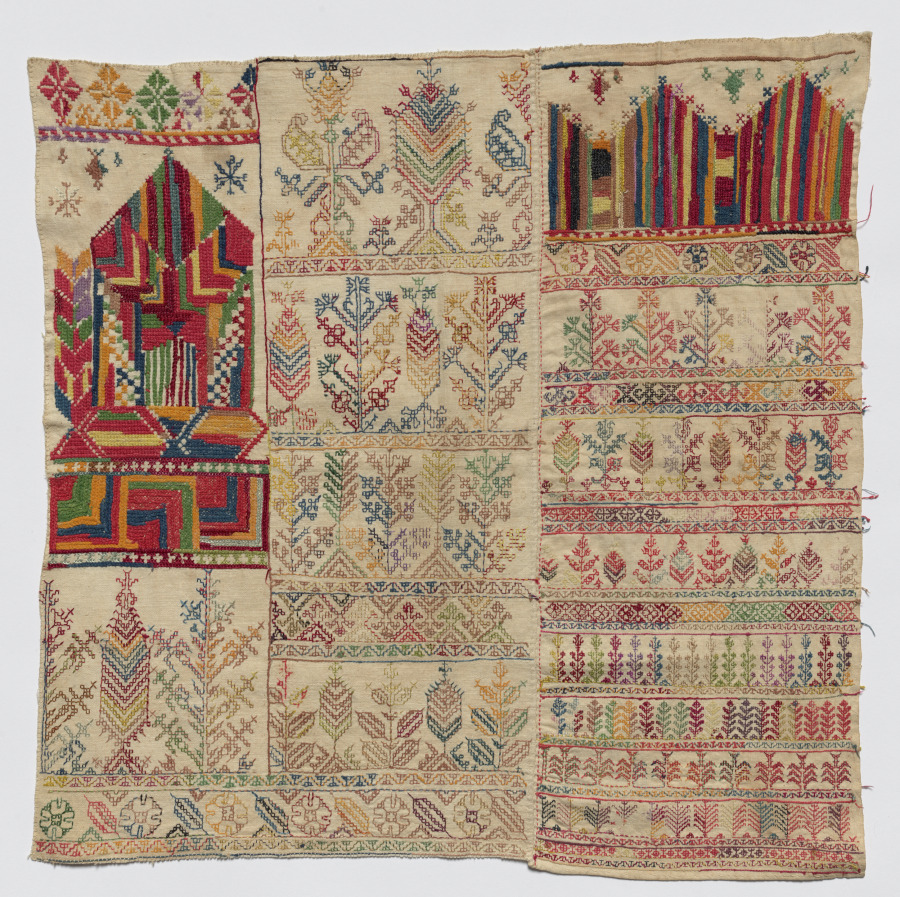
Embroidery sampler (chelliga/shelliga) (c. 1700s) is in the Cleveland Museum of Art collection.
The work and its context
The museum's open-access catalogue describes the work:
These detailed samplers demonstrate the artist's technical range. Here, floral designs, protective open-palm hand motifs (khamsa) and various patterns are embroidered using double-running stitches, straight stitches, and long-armed cross stitches with dyed silk thread. Young women from all social classes would learn these skills from a master craftswoman (mu'allima), who taught within her home.
Object facts
- Title: Embroidery sampler (chelliga/shelliga)
- Date: c. 1700s
- Culture: Africa, North Africa, Morocco, Moroccan embroiderer
- Type: Sampler
- Technique: Cotton, silk, dye
- Dimensions: Overall: 58.4 x 59.1 cm (23 x 23 1/4 in.)
- Collection: T - Islamic
- Department: Textiles
- Accession number: 1929.831
A detail from the museum
Upon completing their training, professionally-trained young women would produce a sampler as a "diploma" testifying to their embroidery skills.
Collection credit
Educational Purchase Fund
Further reading listed by the museum
- Stone, Caroline. The Embroideries of North Africa. Burnt Mill, Harlow, Essex: Longman, 1985.
- Paydar, Niloo Imami, and Ivo Grammet. The Fabric of Moroccan Life. Indianapolis, Ind: Indianapolis Museum of Art, 2002.
- Denamur, Isabelle, Pierre Ferbos, and Louise Rogers Lalaurie. Moroccan textile embroidery. Paris: Flammarion, 2003.
View the collection record
See the museum's photographs and full catalogue entry. Catalogue text is reproduced from the Cleveland Museum of Art's open-access data, with HTML formatting removed. This object and its supplied image are designated CC0.
Sources
More in Lifestyle
Keep reading
Related stories