Figure of a Pair (late 1800s–early 1900s): Art, History and Details
Figure of a Pair at the Cleveland Museum of Art: late 1800s–early 1900s, Wood and iron. Explore the work's context, creator attribution and collection history.
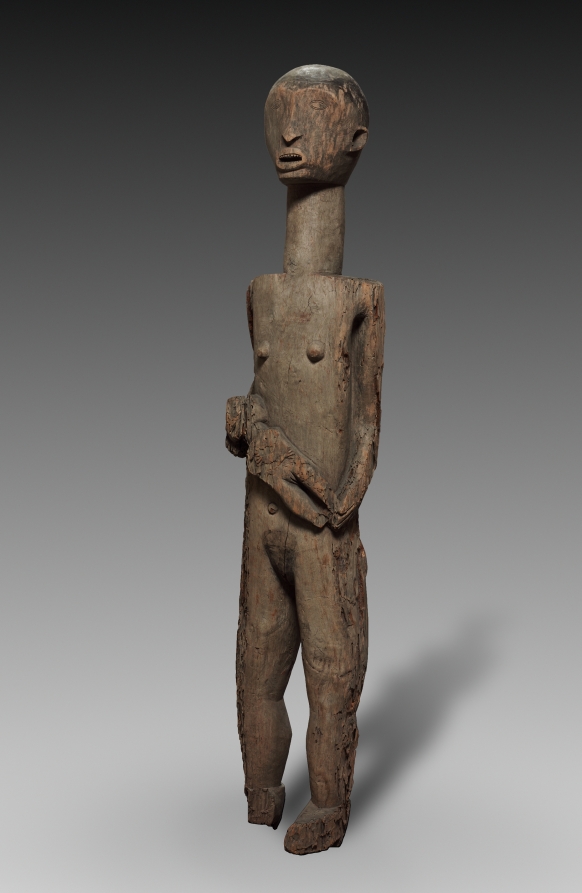
Figure of a Pair (late 1800s–early 1900s) is in the Cleveland Museum of Art collection.
The work and its context
The museum's open-access catalogue describes the work:
The Ubangi region's history of successive migrations and assimilations has resulted in numerous exchanges of religious beliefs and ritual practices. Despite some stylistic traits, including the heart-shaped faces and the male's crested coiffure, this figure with its female pair is unlike any other in the Ubangian corpus. Based on indirect evidence, the pair is said to represent the culture's primordial couple.
Object facts
- Title: Figure of a Pair
- Date: late 1800s–early 1900s
- Culture: Africa, Central Africa, Democratic Republic of the Congo or Central African Republic (most likely), possibly Monzombo-style maker
- Type: Sculpture
- Technique: Wood and iron
- Dimensions: Overall: 145 x 26.8 x 23.3 cm (57 1/16 x 10 9/16 x 9 3/16 in.)
- Collection: African Art
- Department: African Art
- Accession number: 2010.460.2
A detail from the museum
There are no other carved mother-child figures that originate from the Monzombo ethnic group.
Collection credit
René and Odette Delenne Collection, Leonard C. Hanna Jr. Fund
Further reading listed by the museum
- Grootaers, Jan-Lodewijk, ed. Ubangi. Art et cultures au Coeur de l'Afrique, fig. I.4. Exh. Cat. Brussels: Fonds Mercator, in association with Afrika Museum, October 13, 2007-March 31, 2008.
- Petridis, Constantine, et al. Fragments of the Invisible: The René and Odette Delenne Collection of Congo Sculpture. Cleveland, OH: Cleveland Museum of Art. Milan: 5 Continents Editions, 2013, 27, 88, 92-93.
View the collection record
See the museum's photographs and full catalogue entry. Catalogue text is reproduced from the Cleveland Museum of Art's open-access data, with HTML formatting removed. This object and its supplied image are designated CC0.
Sources
More in Lifestyle
Keep reading
Related stories