Flying Hanuman (900s): Art, History and Details
Flying Hanuman at the Cleveland Museum of Art: 900s, bronze. Explore the work's context, creator attribution and collection history.
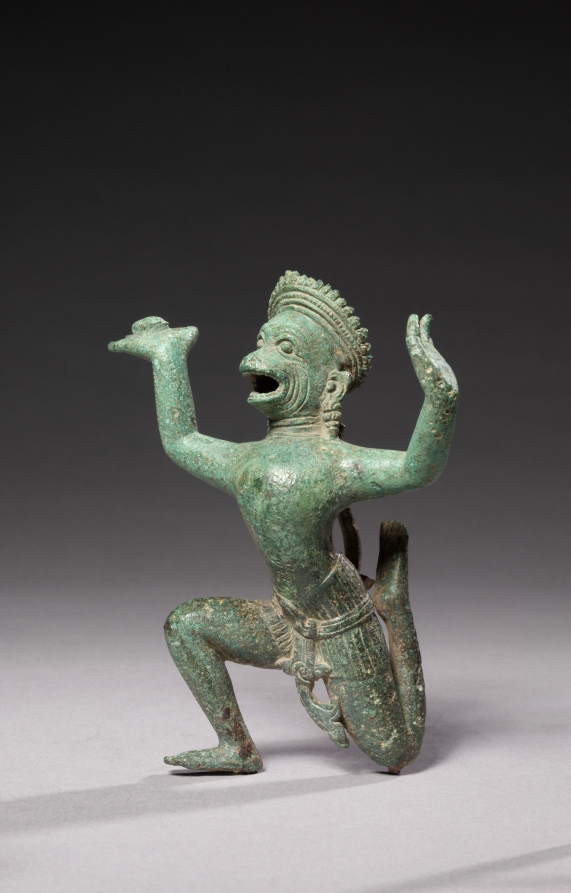
Flying Hanuman (900s) is in the Cleveland Museum of Art collection.
The work and its context
The museum's open-access catalogue describes the work:
Hanuman is most prominently featured in the Indian epic Ramayana, which had gained popularity in Cambodia by the 600s. In a dramatic scene from the epic, Hanuman, who is able to fly, raises his left hand in a gesture meaning "Fear not!" In his raised right hand he carries an antidote to a poison that has rendered the hero Rama and his brother paralyzed and dying. This antidote from the Himalaya Mountains will restore them to full vigor so that they will be able to win the war against the demons and rescue Rama's wife Sita. The garment's wide parallel pleat lines, the swinging flared swath between his legs, the tiered conical crown, and the broad volumes of the chest are stylistic hallmarks of Khmer art of the tenth century.
Object facts
- Title: Flying Hanuman
- Date: 900s
- Culture: Cambodia, Koh Ker style, 10th century
- Type: Sculpture
- Technique: bronze
- Dimensions: Overall: 15.2 x 15 x 7 cm (6 x 5 7/8 x 2 3/4 in.)
- Collection: Cambodian Art
- Department: Indian and Southeast Asian Art
- Accession number: 1987.43
Collection credit
Severance and Greta Millikin Purchase Fund
Further reading listed by the museum
- Turner, Evan H. “The Year in Review for 1987.” The Bulletin of the Cleveland Museum of Art 75, no. 2 (February 1988): 30–71.
View the collection record
See the museum's photographs and full catalogue entry. Catalogue text is reproduced from the Cleveland Museum of Art's open-access data, with HTML formatting removed. This object and its supplied image are designated CC0.
Sources
More in Lifestyle
Keep reading