Folio from a Qur'an (1100s): Art, History and Details
Folio from a Qur'an at the Cleveland Museum of Art: 1100s, ink, gold, and colors on paper. Explore the work's context, creator attribution and collection history.
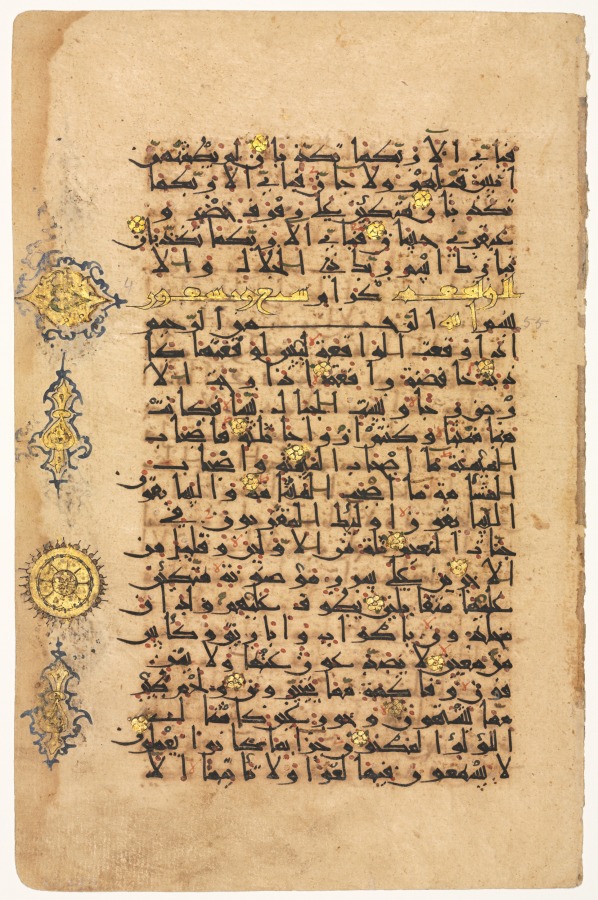
Folio from a Qur'an (1100s) is in the Cleveland Museum of Art collection.
The work and its context
The museum's open-access catalogue describes the work:
East Persian ornamental Kufic (a script used for Qur’an transcriptions) in black, red, and gold fill this page, which is additionally decorated with gold and blue medallions on its border. Twenty-three lines from the Qur’an’s Surah al-Waqi'ah (The Event, or Day of Resurrection; 56: 1–26) are on the recto and 23 lines from Surah al-Rahman (The Compassionate, 55: 73–78) are on the verso.
Object facts
- Title: Folio from a Qur'an
- Date: 1100s
- Culture: Iran, Seljuq period (1037–1194)
- Type: Calligraphy
- Technique: ink, gold, and colors on paper
- Dimensions: Sheet: 30.6 x 20 cm (12 1/16 x 7 7/8 in.)
- Collection: Islamic Art
- Department: Islamic Art
- Accession number: 1933.488
A detail from the museum
Kufic script was named after the ancient Mesopotamian city Kufa (in today’s Iraq), where it developed.
Collection credit
Edward L. Whittemore Fund
Further reading listed by the museum
- Bulletin, Museum of Fine Arts, Boston, XXVII, no. 162, p. 51
View the collection record
See the museum's photographs and full catalogue entry. Catalogue text is reproduced from the Cleveland Museum of Art's open-access data, with HTML formatting removed. This object and its supplied image are designated CC0.
Sources
More in Lifestyle
Keep reading