Four Elders of Mt. Shang (1600s): Art, History and Details
Four Elders of Mt. Shang at the Cleveland Museum of Art: 1600s, One of a pair of six-panel folding screens; ink on paper. Explore the work's context, creator attribution and collection history.
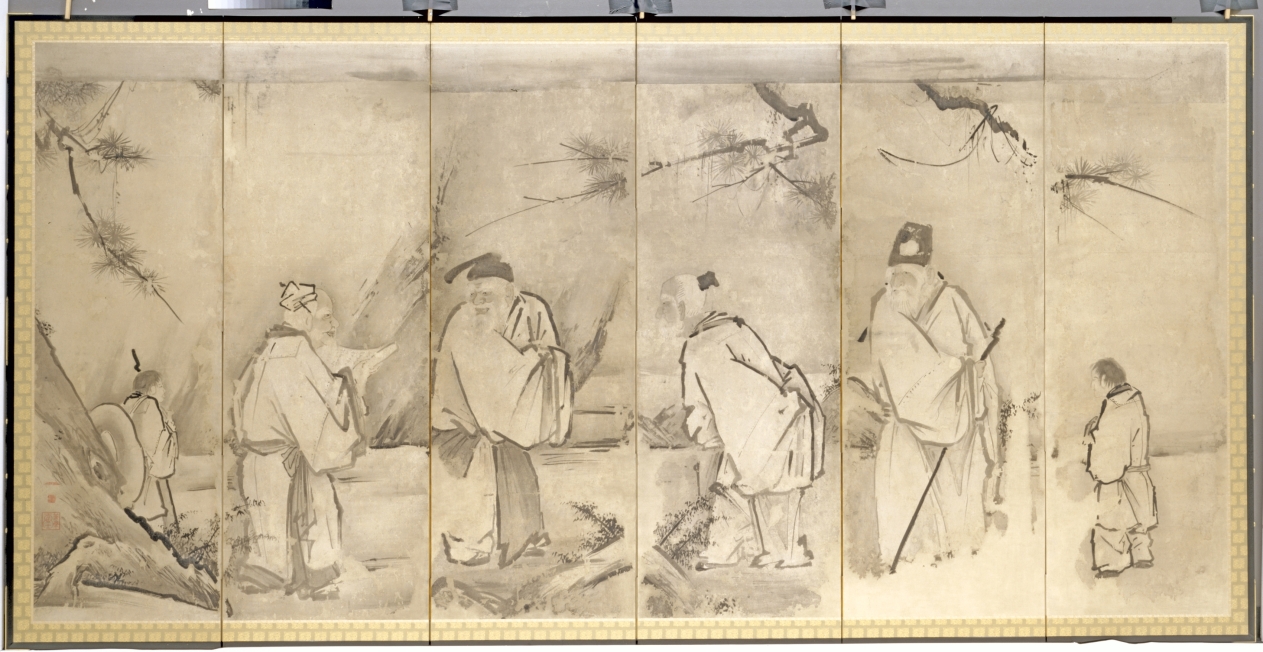
Four Elders of Mt. Shang (1600s) is in the Cleveland Museum of Art collection. The museum's creator attribution is Kano Tan’yū (Japanese, 1602–1674).
The work and its context
The museum's open-access catalogue describes the work:
The Kano school was a group of professional artists patronized by the shogun from the late Muromachi period to the Edo period. The group adopted themes of reclusiveness to convey the importance of loyalty to the shogunate. A leader of the Edo Kano school, Kano Tanyu paired Seven Sages of the Bamboo Grove and Four Elders of Mt. Shang to reference a painting of the same theme attributed to Kano Motonobu. Seven Sages of the Bamboo Grove refers to the elites who escaped the social chaos of China’s Wei-Jin period (AD 200s–400s); they fled to a secluded bamboo grove where they could express themselves freely, enjoying pure conversation, music, and wine. The other screen, Four Elders of Mt. Shang, depicts the scholars who left the turbulence of the late Qin dynasty to pursue their scholarly interests in seclusion on Mt. Shang in Shanxi province.
Object facts
- Title: Four Elders of Mt. Shang
- Date: 1600s
- Creator attribution: Kano Tan’yū (Japanese, 1602–1674)
- Culture: Japan, Edo period (1615–1868)
- Type: Painting
- Technique: One of a pair of six-panel folding screens; ink on paper
- Dimensions: Overall: 161 x 339 cm (63 3/8 x 133 7/16 in.)
- Collection: ASIAN - Folding screen
- Department: Japanese Art
- Accession number: 1979.78.2
Collection credit
Gift of Osborne and Gratia Hauge and Victor and Takako Hauge
Further reading listed by the museum
- Lee, Sherman E. "The Year in Review for 1979." The Bulletin of the Cleveland Museum of Art 67, no. 3 (1980): 58–99.
- Cunningham, Michael R. “Byōbu: The Art of the Japanese Screen.” The Bulletin of the Cleveland Museum of Art 71, no. 7 (September 1984): 223–232.
- Cunningham, Michael R. Unfolding Beauty: Japanese Screens from the Cleveland Museum of Art. Cleveland, OH: Cleveland Museum of Art, 2001.
View the collection record
See the museum's photographs and full catalogue entry. Catalogue text is reproduced from the Cleveland Museum of Art's open-access data, with HTML formatting removed. This object and its supplied image are designated CC0.
Sources
More in Lifestyle
Keep reading