Fragment from Black-Figure Neck-Amphora (Storage Vessel): Satyr and Horse (c. 520–510 BCE): Art, History and Details
Fragment from Black-Figure Neck-Amphora (Storage Vessel): Satyr and Horse at the Cleveland Museum of Art: c. 520–510 BCE, ceramic. Explore the work's context, creator attribution and collection history.
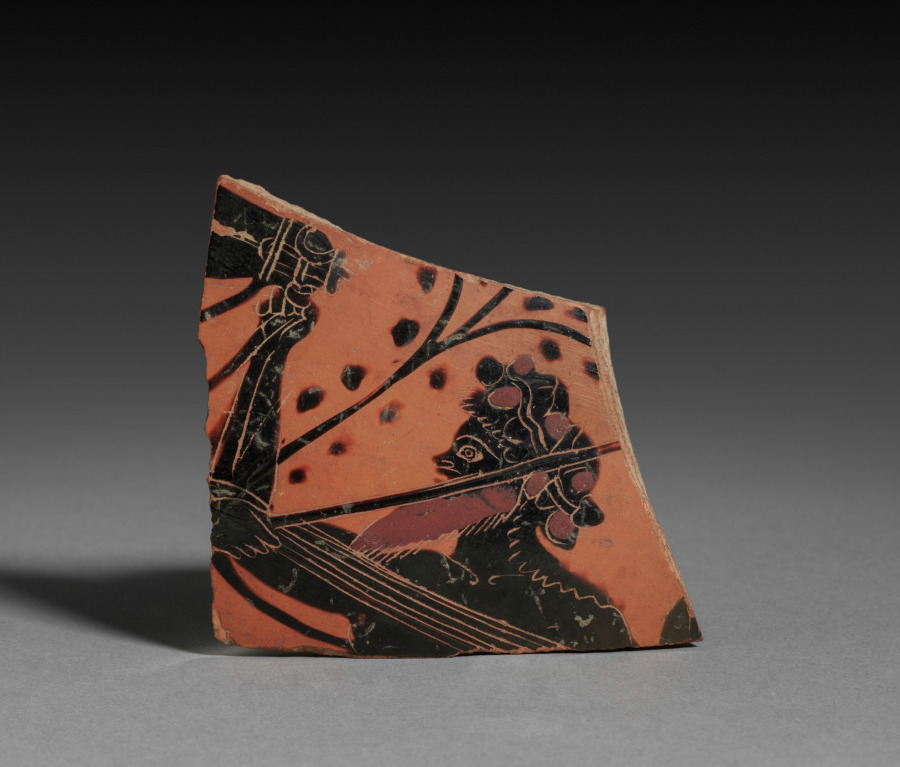
Fragment from Black-Figure Neck-Amphora (Storage Vessel): Satyr and Horse (c. 520–510 BCE) is in the Cleveland Museum of Art collection.
The work and its context
The museum's open-access catalogue describes the work:
This small fragment preserves part of a harnessing scene. At left is part of the muzzled head of a horse, guided by a red-bearded satyr wearing a wreath. Before him are the hands of a charioteer—perhaps Dionysos—holding reins and a goad, with a branch in the background. The unfinished interior identifies this as part of a closed vessel, likely a neck-amphora.
Object facts
- Title: Fragment from Black-Figure Neck-Amphora (Storage Vessel): Satyr and Horse
- Date: c. 520–510 BCE
- Culture: Greek, Attic
- Type: Ceramic
- Technique: ceramic
- Dimensions: Overall: 0.9 cm (3/8 in.)
- Collection: GR - Greek
- Department: Greek and Roman Art
- Accession number: 1915.533.c
A detail from the museum
Greek horsemen often muzzled their horses to prevent biting.
Collection credit
Gift of the John Huntington Art and Polytechnic Trust
Further reading listed by the museum
- Beazley Archive. Beazley Archive Pottery Database. Oxford: Beazley Archive, n.d.
- Boulter, C. G., Jenifer Neils, and Gisela Walberg. Corpus Vasorum Antiquorum. Princeton, N.J.: Princeton University Press, 1971.
View the collection record
See the museum's photographs and full catalogue entry. Catalogue text is reproduced from the Cleveland Museum of Art's open-access data, with HTML formatting removed. This object and its supplied image are designated CC0.
Sources
More in Lifestyle
Keep reading