Fragment with Equestrian Falconer King (prior to 1971): Art, History and Details
Fragment with Equestrian Falconer King at the Cleveland Museum of Art: prior to 1971, Silk: lampas weave. Explore the work's context, creator attribution and collection history.
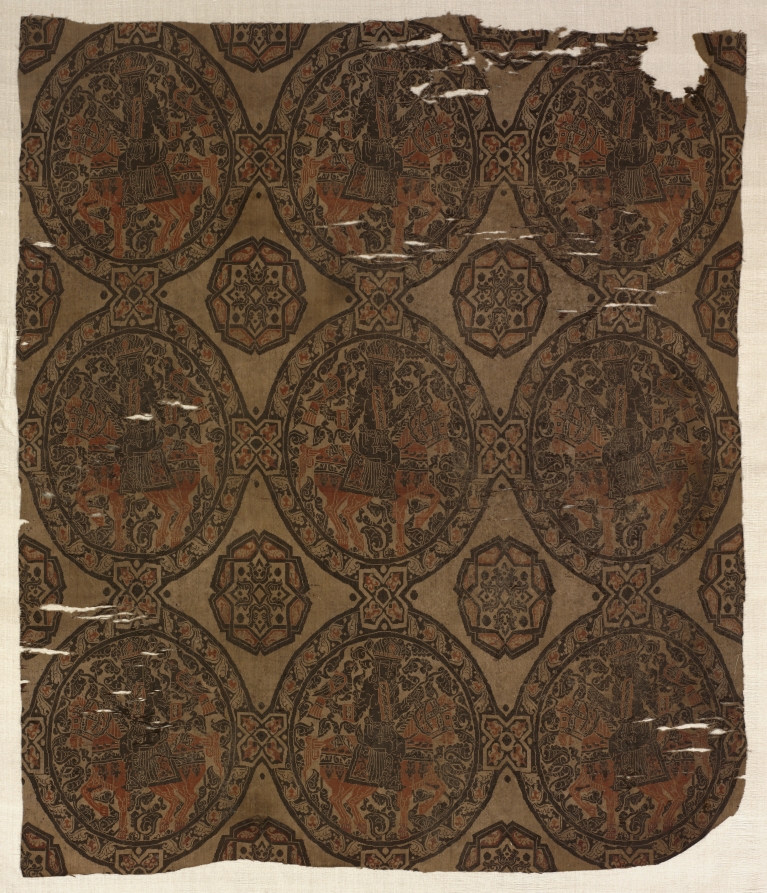
Fragment with Equestrian Falconer King (prior to 1971) is in the Cleveland Museum of Art collection.
The work and its context
The museum's open-access catalogue describes the work:
In three rows, this fragment preserves nine complete aligned, tangent roundels, each containing a king on horseback with a falcon in his left hand and a leafy branch in his right. The border of each roundel is ornamented with a scrolling foliate vine. Interspaces contain oval medallions enclosing an eight-pointed star within which is a four-directional palmette. Joining the roundels at their cardinal points are cross-shaped geometric figures. According to recent analysis of the museum’s Buyid and Abbasid textile materials, some have been identified as modern reproductions.
Object facts
- Title: Fragment with Equestrian Falconer King
- Date: prior to 1971
- Culture: Iran or Iraq, in the style of the Abbasid period (750–1258)
- Type: Textile
- Technique: Silk: lampas weave
- Dimensions: Overall: 103.2 x 86.4 cm (40 5/8 x 34 in.)
- Collection: T - Islamic
- Department: Textiles
- Accession number: 1971.23
Collection credit
Purchase from the J. H. Wade Fund
Further reading listed by the museum
- Lee, Sherman E. “The Year in Review for 1971.” The Bulletin of the Cleveland Museum of Art, vol. 59, no. 1, 1972, pp. 3–46.
- The Cleveland Museum of Art. Handbook of the Cleveland Museum of Art/1978. Cleveland, OH: The Cleveland Museum of Art, 1978.
- Blair, Sheila S., et al. “Reevaluating the Date of the ‘Buyid’ Silks by Epigraphic and Radiocarbon Analysis.” Ars Orientalis, vol. 22, 1992, pp. 1–41.
View the collection record
See the museum's photographs and full catalogue entry. Catalogue text is reproduced from the Cleveland Museum of Art's open-access data, with HTML formatting removed. This object and its supplied image are designated CC0.
Sources
More in Lifestyle
Keep reading