Fragment with falconer riding a bull in a rondel (1000s–1100s (radiocarbon date, 95% probability)): Art, History and Details
Fragment with falconer riding a bull in a rondel at the Cleveland Museum of Art: 1000s–1100s (radiocarbon date, 95% probability), Silk: double cloth. Explore the work's context, creator attribution and collection history.
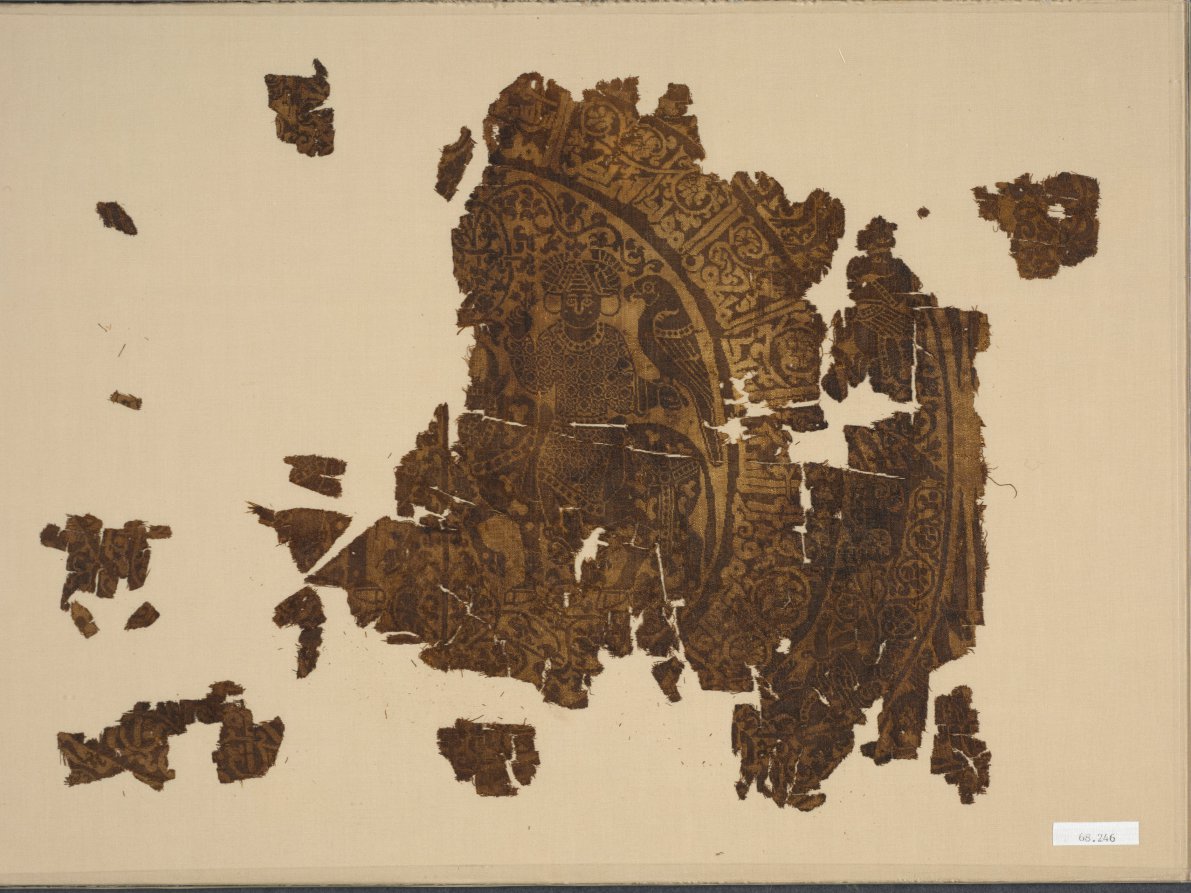
Fragment with falconer riding a bull in a rondel (1000s–1100s (radiocarbon date, 95% probability)) is in the Cleveland Museum of Art collection.
The work and its context
The museum's open-access catalogue describes the work:
The princely sport of falconry was frequently represented in medieval luxury silks. Here, the falconer wears a jeweled turban, the most significant item of men’s dress, and rides sidesaddle on a bull. His tunic displays two small designs: overlapping octagons and the conventional star and cross motif. On his gloved hand, he probably supports a coveted gyrfalcon, a large, superior bird. The border displays an inner inscription and an outer animal procession, an ancient Near Eastern theme, of real and mythical creatures. This double cloth has two distinct layers that exchange position according to the pattern. The crisply broken edges and scattered brittle threads are typical of the fragility of authentic medieval Iranian silks.
Object facts
- Title: Fragment with falconer riding a bull in a rondel
- Date: 1000s–1100s (radiocarbon date, 95% probability)
- Culture: Iran, Rayy, Seljuk period
- Type: Textile
- Technique: Silk: double cloth
- Dimensions: Overall: 28 x 25.4 cm (11 x 10 in.)
- Collection: T - Islamic
- Department: Textiles
- Accession number: 1968.246
A detail from the museum
The falconer's round face with delicate features represents the ideal Iranian beauty, complemented by the chic round hairballs beside his cheeks.
Collection credit
Gift of Ayyub Rabenou
Further reading listed by the museum
- Lee, Sherman E. “The Year in Review for 1968.” The Bulletin of the Cleveland Museum of Art 56, no. 1 (January 1969): 3–50.
- Blair, Sheila S., Jonathan M. Bloom, and Anne E. Wardwell. "Reevaluating the Date of the "Buyid" Silks by Epigraphic and Radiocarbon Analysis." Ars Orientalis 22 (1992): 1–41.
- Mackie, Louise W. Symbols of Power: Luxury Textiles from Islamic Lands, 7th-21st Century. Cleveland; New Haven: Cleveland Museum of Art; Yale University Press, 2015.
View the collection record
See the museum's photographs and full catalogue entry. Catalogue text is reproduced from the Cleveland Museum of Art's open-access data, with HTML formatting removed. This object and its supplied image are designated CC0.
Sources
More in Lifestyle
Keep reading