Fragment with Octagons and Four-Pointed Stars (1521–1955 (radiocarbon date, 95% probability)): Art, History and Details
Fragment with Octagons and Four-Pointed Stars at the Cleveland Museum of Art: 1521–1955 (radiocarbon date, 95% probability), Silk: lampas weave. Explore the work's context, creator attribution and collection history.
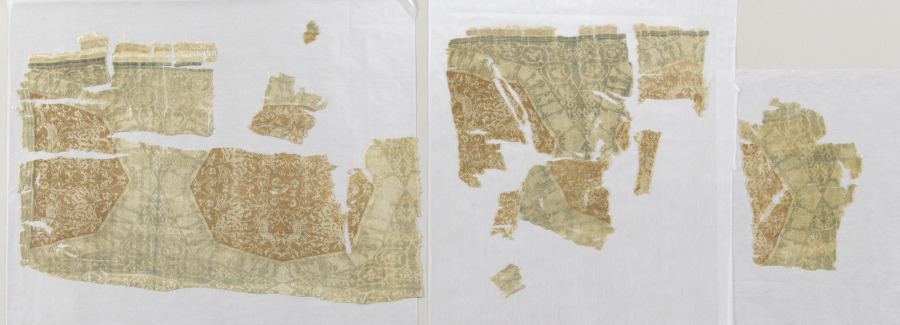
Fragment with Octagons and Four-Pointed Stars (1521–1955 (radiocarbon date, 95% probability)) is in the Cleveland Museum of Art collection.
The work and its context
The museum's open-access catalogue describes the work:
The design consists of aligned large-scale octagons and four-pointed star-shaped interspaces filled with leafy scrolls. Each octagon encloses pairs of regardant gazelles and nonregardant rabbits in mirror image against a foliate background, patterned in white on a light pinkish-tan ground.
Object facts
- Title: Fragment with Octagons and Four-Pointed Stars
- Date: 1521–1955 (radiocarbon date, 95% probability)
- Culture: Iran ?, in the style of the Buyid period (945–1055)
- Type: Textile
- Technique: Silk: lampas weave
- Dimensions: Overall: 26.5 x 100.5 cm (10 7/16 x 39 9/16 in.)
- Collection: T - Islamic
- Department: Textiles
- Accession number: 1982.281
Collection credit
Purchase from the J. H. Wade Fund
Further reading listed by the museum
- Blair, Sheila S., Jonathan M. Bloom, and Anne E. Wardwell. "Reevaluating the Date of the "Buyid" Silks by Epigraphic and Radiocarbon Analysis." Ars Orientalis 22 (1992): 1-41.
View the collection record
See the museum's photographs and full catalogue entry. Catalogue text is reproduced from the Cleveland Museum of Art's open-access data, with HTML formatting removed. This object and its supplied image are designated CC0.
Sources
More in Lifestyle
Keep reading