The monkey slain, his blood to be used as medicine for the ailing prince he has bitten, from a Tuti-nama (Tales of a Parrot): Fifth Night (c. 1560): Art, History and Details
The monkey slain, his blood to be used as medicine for the ailing prince he has bitten, from a Tuti-nama (Tales of a Parrot): Fifth Night at the Cleveland Museum of Art: c. 1560, gum tempera, ink, and gold on paper. Explore the work's conte
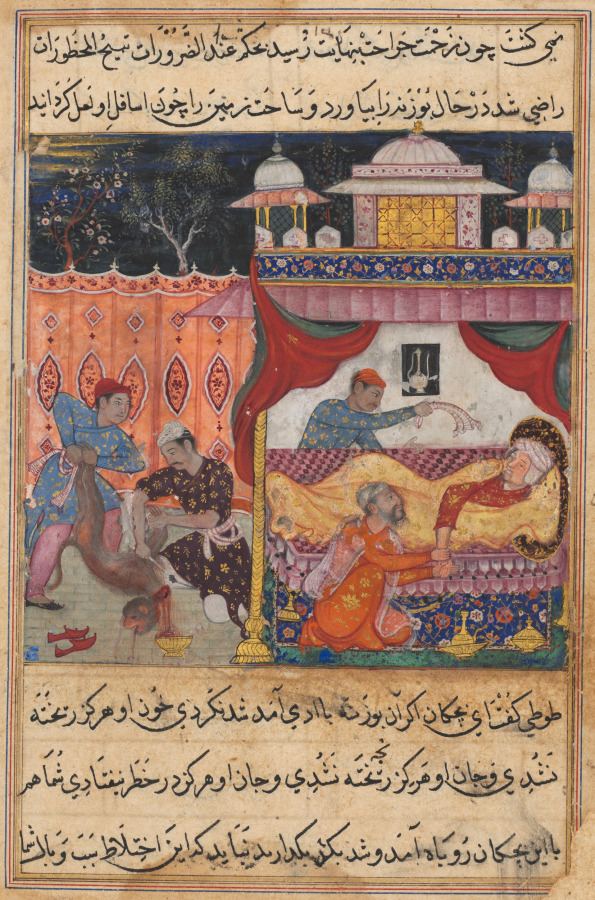
The monkey slain, his blood to be used as medicine for the ailing prince he has bitten, from a Tuti-nama (Tales of a Parrot): Fifth Night (c. 1560) is in the Cleveland Museum of Art collection. The museum's creator attribution is Basawan (Indian, active mid-1500s).
The work and its context
The museum's open-access catalogue describes the work:
Wounded by the chess-playing monkey’s bite, the prince’s hand became increasingly infected. The only cure, his doctors said, was to apply the blood of the monkey to the wound and let it dry. Reluctantly, the prince allowed the monkey to be killed. Two men accomplish this serious work at the left. In the right margin is written the name of the artist, the celebrated Basavana. The Tuti-nama contains the earliest known paintings by the prolific master who was instrumental in shaping the Mughal painting style over subsequent decades.
Object facts
- Title: The monkey slain, his blood to be used as medicine for the ailing prince he has bitten, from a Tuti-nama (Tales of a Parrot): Fifth Night
- Date: c. 1560
- Creator attribution: Basawan (Indian, active mid-1500s)
- Culture: Mughal India, court of Akbar (reigned 1556–1605)
- Type: Painting
- Technique: gum tempera, ink, and gold on paper
- Dimensions: Overall: 20.3 x 14 cm (8 x 5 1/2 in.); Painting only: 10.3 x 10.6 cm (4 1/16 x 4 3/16 in.)
- Collection: Indian Art
- Department: Indian and Southeast Asian Art
- Accession number: 1962.279.33.b
A detail from the museum
Under the covers is the hand that got infected from the monkey bite.
Collection credit
Gift of Mrs. A. Dean Perry
Further reading listed by the museum
- Chandra, Pramod, and Daniel J. Ehnbom. The Cleveland Tuti-Nama Manuscript and the Origins of Mughal Painting. [Cleveland]: Cleveland Museum of Art, 1976.
- Chandra, Pramod, and Daniel J. Ehnbom. The Cleveland Tuti-Nama Manuscript and the Origins of Mughal Painting. [Cleveland]: Cleveland Museum of Art, 1976.
- Seyller, John. “Overpainting in the Cleveland T̤ūtīnāma.” Artibus Asiae 52, no. 3/4 (1992): 283-318.
View the collection record
See the museum's photographs and full catalogue entry. Catalogue text is reproduced from the Cleveland Museum of Art's open-access data, with HTML formatting removed. This object and its supplied image are designated CC0.
Sources
More in Lifestyle
Keep reading