Shah Jahan holding a spinel and a long Deccan sword, from the Late Shah Jahan Album (c. 1650): Art, History and Details
Shah Jahan holding a spinel and a long Deccan sword, from the Late Shah Jahan Album at the Cleveland Museum of Art: c. 1650, Gum tempera and gold on paper. Explore the work's context, creator attribution and collection history.
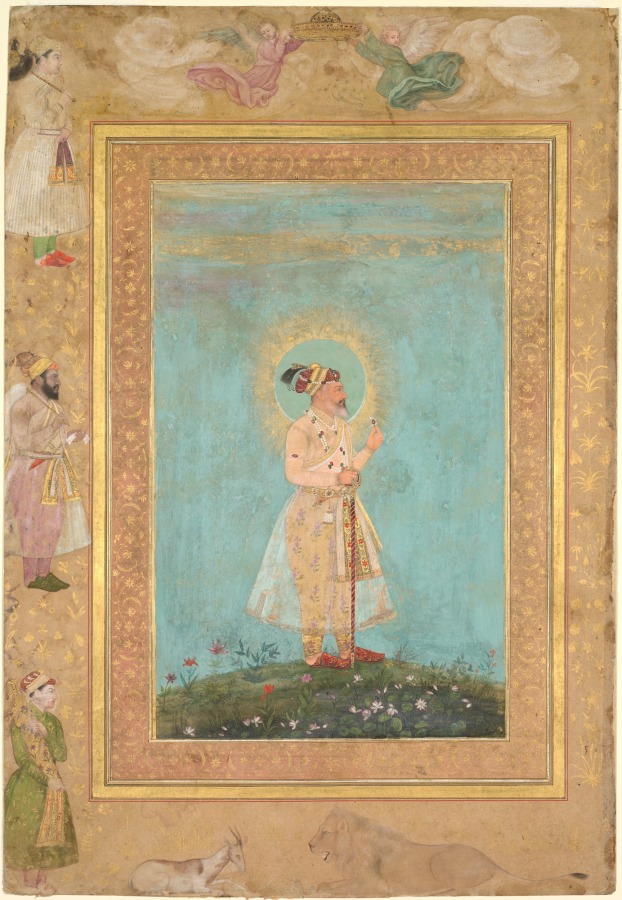
Shah Jahan holding a spinel and a long Deccan sword, from the Late Shah Jahan Album (c. 1650) is in the Cleveland Museum of Art collection.
The work and its context
The museum's open-access catalogue describes the work:
This page came from an imperial album assembled for Shah Jahan toward the end of his reign. Only portraits of the emperors have angels hovering with a crown in the top border along with the predator peacefully paired with his prey below. Shah Jahan chose to link these symbols of peace and justice with divine sanction for his rule, as indicated by the light of the sun and moon behind his head. Royal retainers carry emblems of sovereignty in the left border. Imperial Mughal painting reached a pinnacle of refinement and formality under Shah Jahan. The artists reveal astonishing skill in their ability to render the subtle texture of the feather in his turban crest, the gleam of every jewel, the softness of his beard, and the delicacy of his costly translucent muslin robe. In his hand Shah Jahan holds a ruby-like gemstone called a spinel, prized among the Mughals for its talismanic properties of protection during battle.
Object facts
- Title: Shah Jahan holding a spinel and a long Deccan sword, from the Late Shah Jahan Album
- Date: c. 1650
- Culture: India, Mughal, 17th century
- Type: Painting
- Technique: Gum tempera and gold on paper
- Dimensions: Page: 36.7 x 25.4 cm (14 7/16 x 10 in.)
- Collection: Indian Art - Mughal
- Department: Indian and Southeast Asian Art
- Accession number: 2013.328
A detail from the museum
The finest fabric was the most transparent, like the Emperor’s New Clothes.
Collection credit
Gift in honor of Madeline Neves Clapp; Gift of Mrs. Henry White Cannon by exchange; Bequest of Louise T. Cooper; Leonard C. Hanna Jr. Fund; From the Catherine and Ralph Benkaim Collection
Further reading listed by the museum
- Beach, Milo Cleveland, Stuart Cary Welch, and Glenn D. Lowry. The Grand Mogul: Imperial Painting in India, 1600-1660. Williamstown, MA: Sterling and Francine Clark Art Institute, 1978.
- Leach, Linda York. Mughal and Other Indian Paintings from the Chester Beatty Library. London: Scorpion Cavendish, 1995.
- Glynn, Catherine. "Shah Jahan and Pahari painting" in Discerning Eye & Eloquent Line: A Festschrift : Essays to Honor R.E. Lewis on His 75th Birthday. Betsy Geraghty Fryberger, editor. Palo Alto, Calif: Betsy G. Fryberger, 1998.
View the collection record
See the museum's photographs and full catalogue entry. Catalogue text is reproduced from the Cleveland Museum of Art's open-access data, with HTML formatting removed. This object and its supplied image are designated CC0.
Sources
More in Lifestyle
Keep reading