Hemidrachm: Gorgoneion (obverse); Bull (reverse) (c. 400 BCE): Art, History and Details
Hemidrachm: Gorgoneion (obverse); Bull (reverse) at the Cleveland Museum of Art: c. 400 BCE, silver. Explore the work's context, creator attribution and collection history.
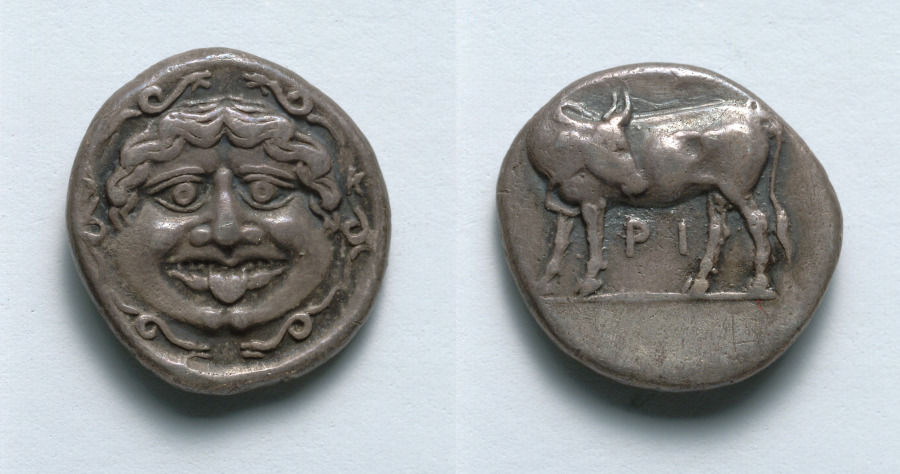
Hemidrachm: Gorgoneion (obverse); Bull (reverse) (c. 400 BCE) is in the Cleveland Museum of Art collection.
The work and its context
The museum's open-access catalogue describes the work:
Like the coins of several other ancient cities, those of Parion feature the gorgoneion, or frontal face of Medusa, surrounded by serpents. On the reverse, a bull looks back across its body, with the letters Ρ Ι between its legs. More centrally struck examples preserve two more letters above—Π Α, to give ΠΑΡΙ (PARI), identifying the mint of Parion. The name recalls that of the Cycladic island Paros, one of Parion’s colonizers (with Miletos and Erythrae).
Object facts
- Title: Hemidrachm: Gorgoneion (obverse); Bull (reverse)
- Date: c. 400 BCE
- Culture: Greek, minted at Parion (Mysia)
- Type: Coins
- Technique: silver
- Dimensions: Diameter: 1.3 cm (1/2 in.)
- Collection: GR - Greek
- Department: Greek and Roman Art
- Accession number: 1917.991
A detail from the museum
Ancient Parion (Latin Parium) lay in the region of Mysia, now northwest Turkey, on the Hellespont.
Collection credit
Gift of the John Huntington Art and Polytechnic Trust
Further reading listed by the museum
- "Accessions." The Bulletin of the Cleveland Museum of Art 4, no. 4 (1917): 64-67.
View the collection record
See the museum's photographs and full catalogue entry. Catalogue text is reproduced from the Cleveland Museum of Art's open-access data, with HTML formatting removed. This object and its supplied image are designated CC0.
Sources
More in Lifestyle
Keep reading