Fragment with running animal roundels and kufic inscriptions (1530–1950 (radiocarbon date, 95% probability)): Art, History and Details
Fragment with running animal roundels and kufic inscriptions at the Cleveland Museum of Art: 1530–1950 (radiocarbon date, 95% probability), Silk: lampas weave, brocaded. Explore the work's context, creator attribution and collection history
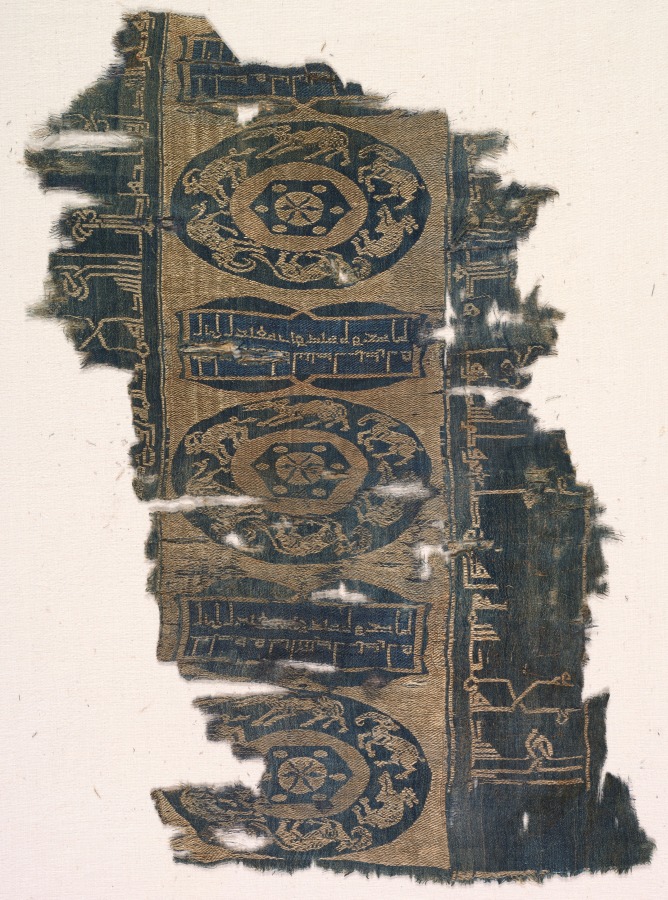
Fragment with running animal roundels and kufic inscriptions (1530–1950 (radiocarbon date, 95% probability)) is in the Cleveland Museum of Art collection.
The work and its context
The museum's open-access catalogue describes the work:
This fragment preserves a wide central band flanked by narrower inscription bands. The narrower bands contain, on a dark blue background a continuous inscription in elaborate Kufic, the ivory-colored lettering oriented at right angles to the warp. On the wider ivory panel there appear ovals enclosing a frieze of running animals within which are hexagons enclosing stars. The ovals alternate vertically with cartouches containing an inscription in simple Kufic, the design appearing in blue, pink, and ivory.
Object facts
- Title: Fragment with running animal roundels and kufic inscriptions
- Date: 1530–1950 (radiocarbon date, 95% probability)
- Culture: Iran, in the style of the Buyid period (945–1055)
- Type: Textile
- Technique: Silk: lampas weave, brocaded
- Dimensions: Overall: 35.3 x 25 cm (13 7/8 x 9 13/16 in.)
- Collection: T - Islamic
- Department: Textiles
- Accession number: 1953.331
Collection credit
Purchase from the J. H. Wade Fund
Further reading listed by the museum
- Blair, Sheila S., Jonathan M. Bloom, and Anne E. Wardwell. "Reevaluating the Date of the "Buyid" Silks by Epigraphic and Radiocarbon Analysis." Ars Orientalis 22 (1992): 1-41.
- Mackie, Louise W. Symbols of Power: Luxury Textiles from Islamic Lands, 7th-21st Century. Cleveland; New Haven: Cleveland Museum of Art; Yale University Press, 2015.
View the collection record
See the museum's photographs and full catalogue entry. Catalogue text is reproduced from the Cleveland Museum of Art's open-access data, with HTML formatting removed. This object and its supplied image are designated CC0.
Sources
More in Lifestyle
Keep reading