Fragments (1420–1955): Art, History and Details
Fragments at the Cleveland Museum of Art: 1420–1955, Silk: compound twill weave. Explore the work's context, creator attribution and collection history.
Fragments (1420–1955) is in the Cleveland Museum of Art collection.
The work and its context
The museum's open-access catalogue describes the work:
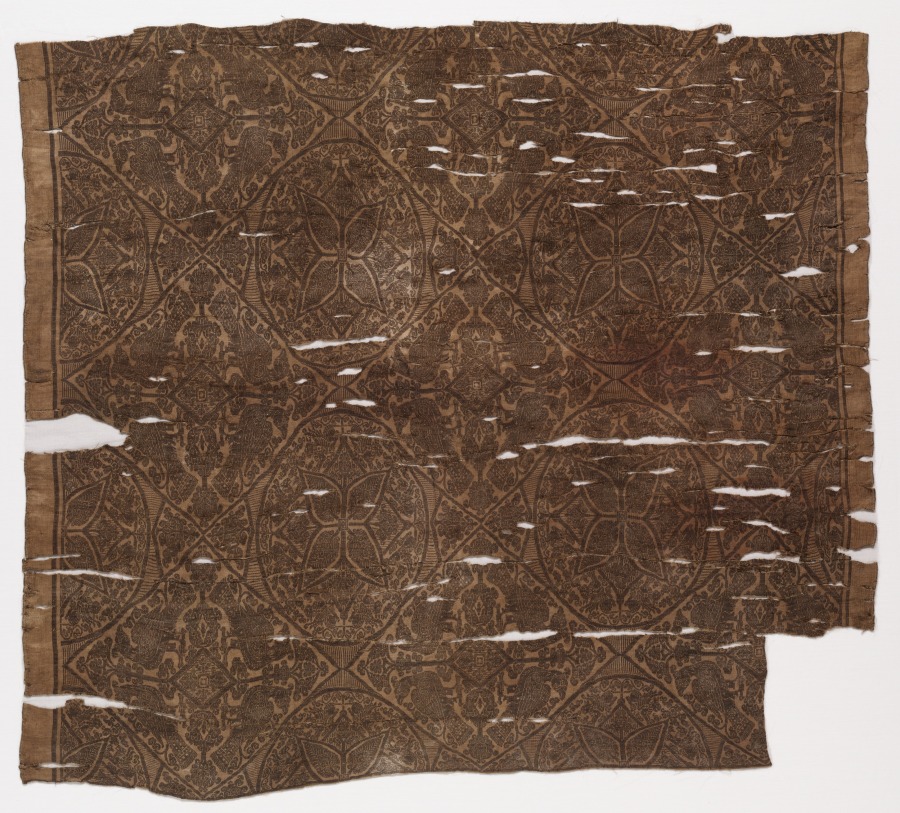
The weave provides different design for each side of this fragment. On the front, the overall lozenge pattern has alternating rows of ornamented ovals and diamonds. The large diamonds have a large four-leaved motif superimposed over a diamond with trees in each corner. The foliate ground with four pairs of opposed griffins fills the interspaces to the oval border. The diamonds have two opposed pairs of birds each flanking a Tree of Life and standing on a plant motif; these enclose a smaller central diamond with trees in each corner and a central square. On the reverse, the plain ground of natural tan has two brown bands with large and small Kufic inscriptions.
Object facts
- Title: Fragments
- Date: 1420–1955
- Culture: Iran or Iraq
- Type: Textile
- Technique: Silk: compound twill weave
- Dimensions: Average: 71 x 77 cm (27 15/16 x 30 5/16 in.)
- Collection: T - Islamic
- Department: Textiles
- Accession number: 1968.225
A detail from the museum
The design is at right angles to the warp.
Collection credit
Purchase from the J. H. Wade Fund
Further reading listed by the museum
- Blair, Sheila S., Jonathan M. Bloom, and Anne E. Wardwell. "Reevaluating the Date of the "Buyid" Silks by Epigraphic and Radiocarbon Analysis." Ars Orientalis 22 (1992): 1-41.
View the collection record
See the museum's photographs and full catalogue entry. Catalogue text is reproduced from the Cleveland Museum of Art's open-access data, with HTML formatting removed. This object and its supplied image are designated CC0.
Sources
More in Lifestyle
Keep reading