Game of Backgammon (1640s): Art, History and Details
Game of Backgammon at the Cleveland Museum of Art: 1640s, oil on wood, transferred to canvas. Explore the work's context, creator attribution and collection history.
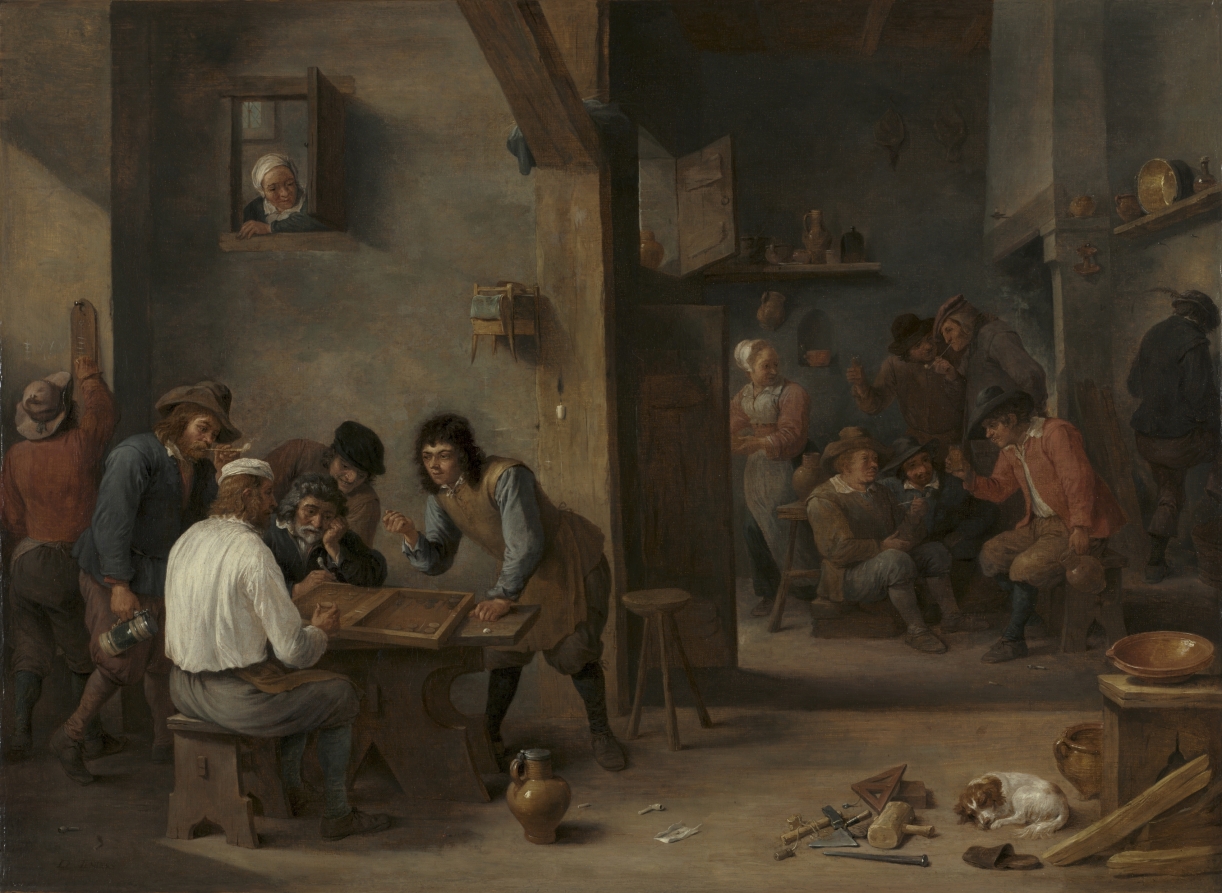
Game of Backgammon (1640s) is in the Cleveland Museum of Art collection. The museum's creator attribution is David Teniers (Flemish, 1610–1690).
The work and its context
The museum's open-access catalogue describes the work:
The game of backgammon has a long and popular history which can be traced back many centuries. The version of the game as it is played in modern times first appeared in the 1400s under various names. Its current appellation was coined around the same time as the date of this painting. Backgammon was exceptionally popular in the 1600s, and was often played for money or other wagers. The two men on the left side of this painting are clearly involved in a high stakes game of backgammon. A three-man cluster has gathered to watch them lay their bets, while another tallies their points on a scoreboard. The young lady in the right corner of the room otherwise surrounded by men and the older women who looks down on the game of backgammon from a window, both indicate that the interior presented in this painting is probably the gaming room of a brothel. Courtesans often worked out of such game rooms, providing further entertainment for men. Depictions of games, like procurement scenes, often symbolized moralizing virtues. Games were considered at best folly and at worst immoral. Backgammon was often used to represent the foolishness or wickedness of betting and wasting one's time.
Object facts
- Title: Game of Backgammon
- Date: 1640s
- Creator attribution: David Teniers (Flemish, 1610–1690)
- Culture: Flanders
- Type: Painting
- Technique: oil on wood, transferred to canvas
- Dimensions: Framed: 82 x 102 x 9 cm (32 5/16 x 40 3/16 x 3 9/16 in.); Unframed: 59 x 80.6 cm (23 1/4 x 31 3/4 in.)
- Collection: P - Netherlandish-Flemish
- Department: European Painting and Sculpture
- Accession number: 1943.377
Collection credit
Gift of Mr. and Mrs. Samuel D. Wise
Further reading listed by the museum
- Dubois de Saint-Gelais, Louis François. Description des tableaux du Palais royal: avec la vie des peintres à la tête de leurs ouvrages : dédiée a monseigneur le Duc d'Orleans, premier prince du Sang. A Paris: Chez d'Houry, seul imprimeur & libraire de monseigneur le Duc d'Orleans, 1727.
- Couche, J., Fontenai, Croze-Magnan, Philippe Orléans, and House of Orleans. Galerie du Palais royal, gravée d'après les tableaux des differentes ecoles qui la composent: avec un abrégé de la vie des peintres & une description historique de chaque tableau. Paris: Chez J. Couché, 1786.
- Buchanan, William. Memoirs of Painting: With a Chronological History of the Importation of Pictures by the Great Masters into England Since the French Revolution. London: Printed for R. Ackerman, 1824.
View the collection record
See the museum's photographs and full catalogue entry. Catalogue text is reproduced from the Cleveland Museum of Art's open-access data, with HTML formatting removed. This object and its supplied image are designated CC0.
Sources
More in Lifestyle
Keep reading