Gigaku Mask of Young Persian Boy (Taikōji) (710–94): Art, History and Details
Gigaku Mask of Young Persian Boy (Taikōji) at the Cleveland Museum of Art: 710–94, paulownia wood, lacquered and painted. Explore the work's context, creator attribution and collection history.
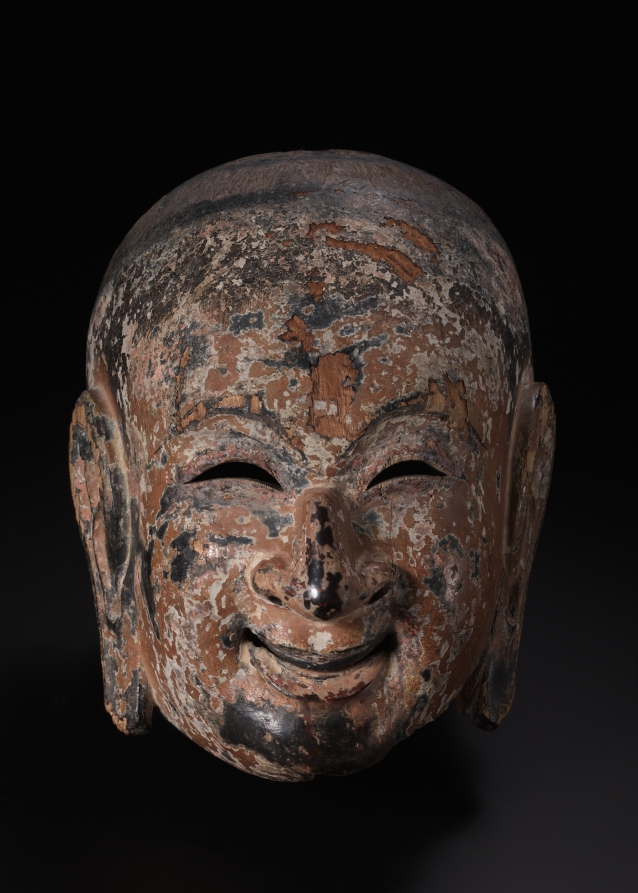
Gigaku Mask of Young Persian Boy (Taikōji) (710–94) is in the Cleveland Museum of Art collection.
The work and its context
The museum's open-access catalogue describes the work:
This mask is for the role of the son of an old Persian widower in gigaku, a theatrical dance repertoire imported to Japan from continental Asia during the seventh century. The old man and his sons mime prayers to the Buddha. While the mask would cover the entire head of the actor, there are openings for the eyes, nostrils, and mouth.
Object facts
- Title: Gigaku Mask of Young Persian Boy (Taikōji)
- Date: 710–94
- Culture: Japan, Nara period (710–94)
- Type: Sculpture
- Technique: paulownia wood, lacquered and painted
- Dimensions: Overall: 28 x 21 x 18.5 cm (11 x 8 1/4 x 7 5/16 in.)
- Collection: Japanese Art
- Department: Japanese Art
- Accession number: 1949.158
A detail from the museum
This is the mask for one of two sons who accompany a widower in ancient dance theater.
Collection credit
John L. Severance Fund
Further reading listed by the museum
- Milliken, William M. “A Gigaku Mask.” The Bulletin of the Cleveland Museum of Art, vol. 37, no. 8, 1950, pp. 176–178.
- Milliken, William M. “Important Acquisitions of Japanese Art.” The Bulletin of the Cleveland Museum of Art, vol. 38, no. 9, 1951, pp. 211–217.
- The Cleveland Museum of Art. The Cleveland Museum of Art Handbook. Cleveland, OH: The Cleveland Museum of Art, 1958.
View the collection record
See the museum's photographs and full catalogue entry. Catalogue text is reproduced from the Cleveland Museum of Art's open-access data, with HTML formatting removed. This object and its supplied image are designated CC0.
Sources
More in Lifestyle
Keep reading