Part of a sari (1700s–1800s): Art, History and Details
Part of a sari at the Cleveland Museum of Art: 1700s–1800s, central panel plain weave (paired weft): silk and metal thread; tapestry weave border. Explore the work's context, creator attribution and collection history.
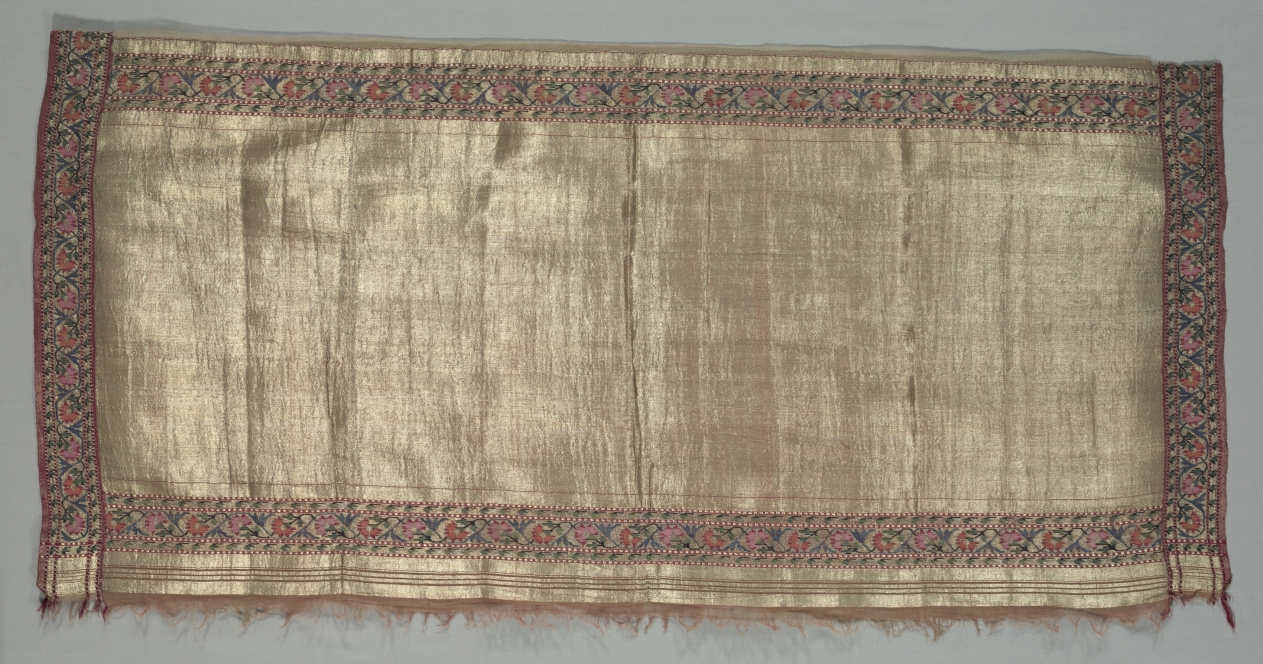
Part of a sari (1700s–1800s) is in the Cleveland Museum of Art collection.
The work and its context
The museum's open-access catalogue describes the work:
This section of an upper garment has been cut down from its original length, with borders applied to the short ends. The rose-colored threads in one direction lend an underlying warmth to the metallic thread woven in the opposite direction that changes hue and sheen as the wearer moves. The border is a flowering vine pattern with alternating pink and orange blossoms.
Object facts
- Title: Part of a sari
- Date: 1700s–1800s
- Culture: India, Mughal, Aurangabad, 18th-19th century
- Type: Textile
- Technique: central panel plain weave (paired weft): silk and metal thread; tapestry weave border
- Dimensions: Overall: 58.4 x 120.7 cm (23 x 47 1/2 in.)
- Collection: Textiles
- Department: Textiles
- Accession number: 1925.670
A detail from the museum
Floral motifs are common in Mughal court art. Roses had associations with love and beauty.
Collection credit
Purchase from the J. H. Wade Fund
View the collection record
See the museum's photographs and full catalogue entry. Catalogue text is reproduced from the Cleveland Museum of Art's open-access data, with HTML formatting removed. This object and its supplied image are designated CC0.
Sources
More in Lifestyle
Keep reading