Goddess Vajravarahi (c. 1040–c. 1310): Art, History and Details
Goddess Vajravarahi at the Cleveland Museum of Art: c. 1040–c. 1310, unbaked clay and pigment. Explore the work's context, creator attribution and collection history.
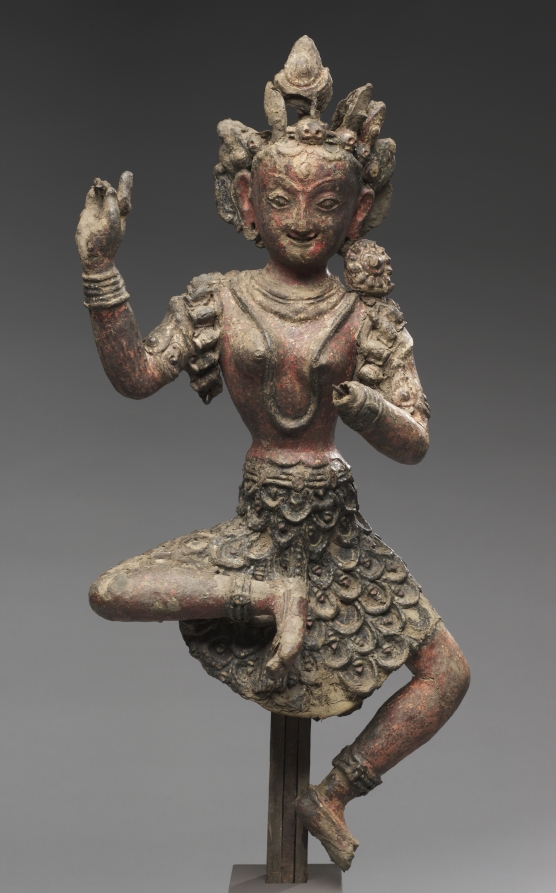
Goddess Vajravarahi (c. 1040–c. 1310) is in the Cleveland Museum of Art collection.
The work and its context
The museum's open-access catalogue describes the work:
This powerful red goddess dances vigorously and raises one hand that would have held a flaying knife, while the other once held a skull cup. Her bone skirt and garland of freshly severed heads complement the skulls that adorn her crown. Her eyes bulge, her brow furrows, and she bares her teeth. These attributes communicate her power to assist her followers in overcoming passions, ignorance, and fear. This is one of the earliest surviving images made of unbaked clay, using an iron armature and rope strings to support the ornament.
Object facts
- Title: Goddess Vajravarahi
- Date: c. 1040–c. 1310
- Culture: Nepal
- Type: Sculpture
- Technique: unbaked clay and pigment
- Dimensions: Overall: 63.5 cm (25 in.)
- Collection: Nepalese Art
- Department: Indian and Southeast Asian Art
- Accession number: 1964.103
A detail from the museum
The wooden post is an original and would have been set into a sculpted corpse.
Collection credit
Andrew R. and Martha Holden Jennings Fund
Further reading listed by the museum
- “Annual Report for 1964.” The Bulletin of the Cleveland Museum of Art, vol. 52, no. 6, 1965, pp. 141–166.
- The Cleveland Museum of Art. Handbook of the Cleveland Museum of Art/1966. Cleveland, OH: The Cleveland Museum of Art, 1966.
- The Cleveland Museum of Art. Handbook of the Cleveland Museum of Art/1969. Cleveland, OH: The Cleveland Museum of Art, 1969.
View the collection record
See the museum's photographs and full catalogue entry. Catalogue text is reproduced from the Cleveland Museum of Art's open-access data, with HTML formatting removed. This object and its supplied image are designated CC0.
Sources
More in Lifestyle
Keep reading