Head of a Bull (3000–2000 BCE): Art, History and Details
Head of a Bull at the Cleveland Museum of Art: 3000–2000 BCE, chalcedony. Explore the work's context, creator attribution and collection history.
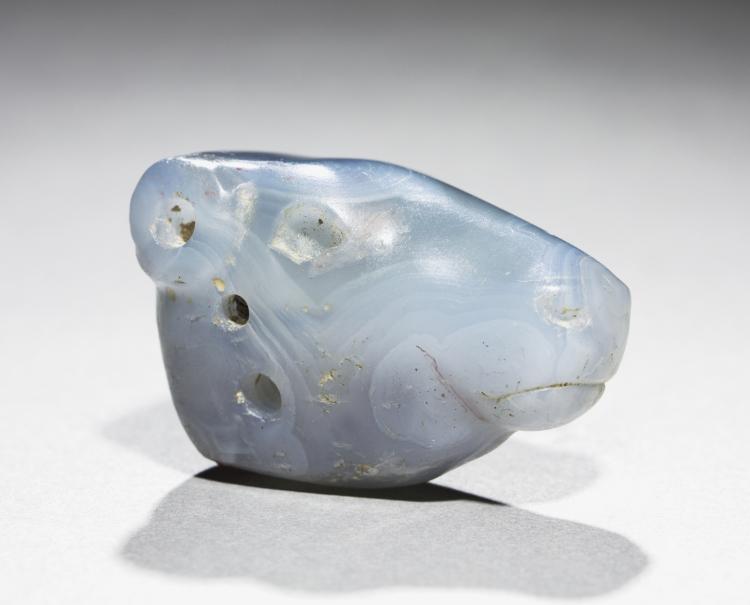
Head of a Bull (3000–2000 BCE) is in the Cleveland Museum of Art collection.
The work and its context
The museum's open-access catalogue describes the work:
This bull head is carved in a banded stone. The sculptor has ingeniously planned the work so that the veins of the stone enhance the anatomy of the head. Inlays of stone, ivory, or gold (now missing) were set into the eyes and horn sockets. The other holes were used to attach the head to a body of a different material.
Object facts
- Title: Head of a Bull
- Date: 3000–2000 BCE
- Culture: Mesopotamia, Sumerian, Iraq, Tigris-Euphrates valley, Early Bronze Age I (c. 3300–c. 3000 BCE)
- Type: Sculpture
- Technique: chalcedony
- Dimensions: Overall: 3.1 x 2.9 x 4.3 cm (1 1/4 x 1 1/8 x 1 11/16 in.)
- Collection: Near Eastern Art
- Department: Egyptian and Ancient Near Eastern Art
- Accession number: 1997.51
A detail from the museum
This object is made of quartz, which is used to make electronics today.
Collection credit
Norman O. Stone and Ella A. Stone Memorial Fund
Further reading listed by the museum
- Cleveland Museum of Art, “Museum Acquires Major Chuck Close Painting, 19th-century Fire Screen, Rare Prints & Drawings,” June 9, 1997, Cleveland Museum of Art Archives.
- Del Bufalo, Dario. Precious portraits: small precious stone sculptures of Imperial Rome. 2020.
View the collection record
See the museum's photographs and full catalogue entry. Catalogue text is reproduced from the Cleveland Museum of Art's open-access data, with HTML formatting removed. This object and its supplied image are designated CC0.
Sources
More in Lifestyle
Keep reading