Head of a Woman Holding a Sistrum (150 BCE–50 CE): Art, History and Details
Head of a Woman Holding a Sistrum at the Cleveland Museum of Art: 150 BCE–50 CE, marble. Explore the work's context, creator attribution and collection history.
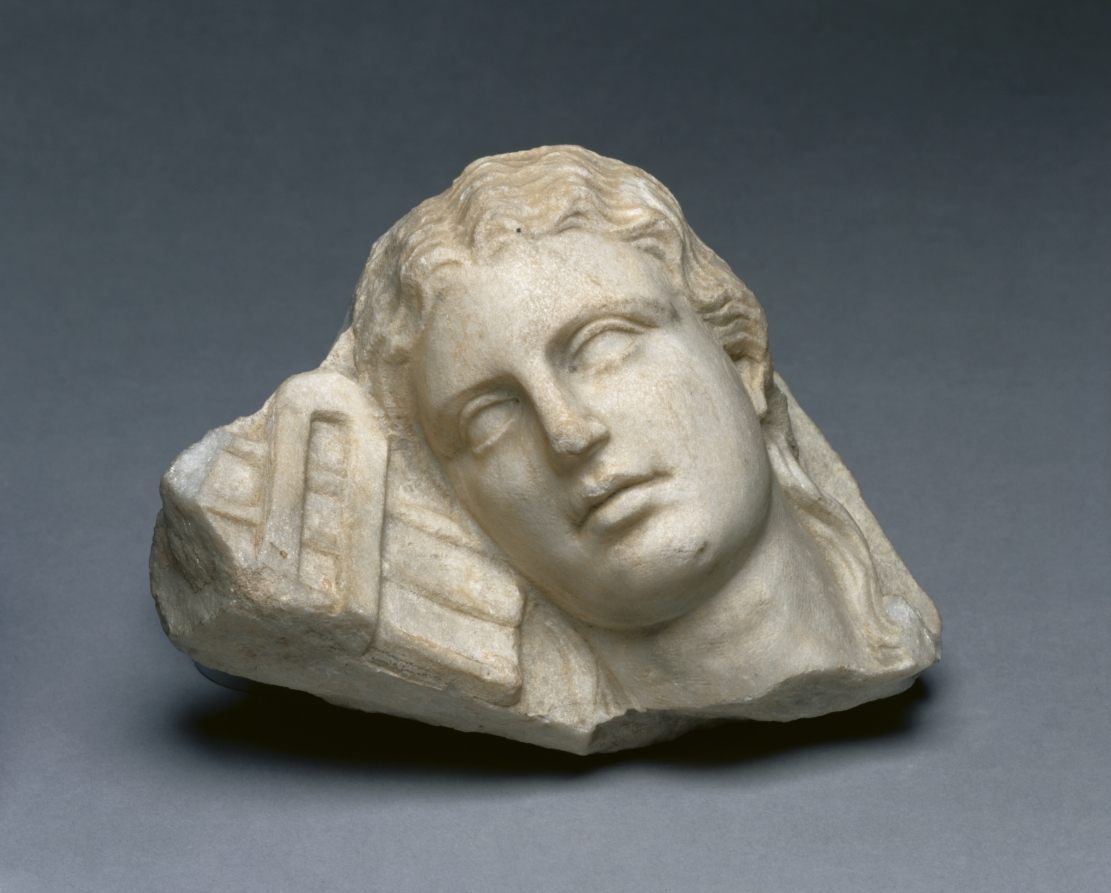
Head of a Woman Holding a Sistrum (150 BCE–50 CE) is in the Cleveland Museum of Art collection.
The work and its context
The museum's open-access catalogue describes the work:
This head of a woman was likely originally part of a stele or grave marker. The woman sits in partial profile holding a sistrum close to her head, possibly making music. A sistrum is a type of rattle that originated in ancient Egypt and spread to the Greek world. (View a sistrum in the collection here: 1920.1990.) The sistrum likely signaled to ancient viewers that the woman on the grave marker was a worshiper of the Egyptian goddess Isis, whose cult spread throughout the Mediterranean after Alexander the Great took over Egypt.
Object facts
- Title: Head of a Woman Holding a Sistrum
- Date: 150 BCE–50 CE
- Type: Sculpture
- Technique: marble
- Dimensions: Overall: 17.7 x 20 x 11.2 cm (6 15/16 x 7 7/8 x 4 7/16 in.)
- Collection: GR - Greek
- Department: Greek and Roman Art
- Accession number: 1929.980
A detail from the museum
A sistrum (rattle) can have either three or four branches through the body of the instrument.
Collection credit
Purchase from the J. H. Wade Fund
Further reading listed by the museum
- Saura-Zeigelmeyet, Arnaud. "Le sistre isiaque dans l'iconographie funéraire impériale: entre symbole visuel sonore et symbole visuel identitaire" in Sébastien Biay, Frédéric Billiet, and Isabelle Marchesin (eds.), Les figurations visuelles de la parole, du son musical et du bruit, de l'Antiquité à la Renaissance, Paris, IReMus 2021, p.83-93.
View the collection record
See the museum's photographs and full catalogue entry. Catalogue text is reproduced from the Cleveland Museum of Art's open-access data, with HTML formatting removed. This object and its supplied image are designated CC0.
Sources
More in Lifestyle
Keep reading