Hexafoil-Shaped Table with Mother-of-Pearl Inlay (late 1400s–early 1500s): Art, History and Details
Hexafoil-Shaped Table with Mother-of-Pearl Inlay at the Cleveland Museum of Art: late 1400s–early 1500s, Inlaid abalone shells on black lacquer ground, applied with red lacquer on the interior. Explore the work's context, creator attributio
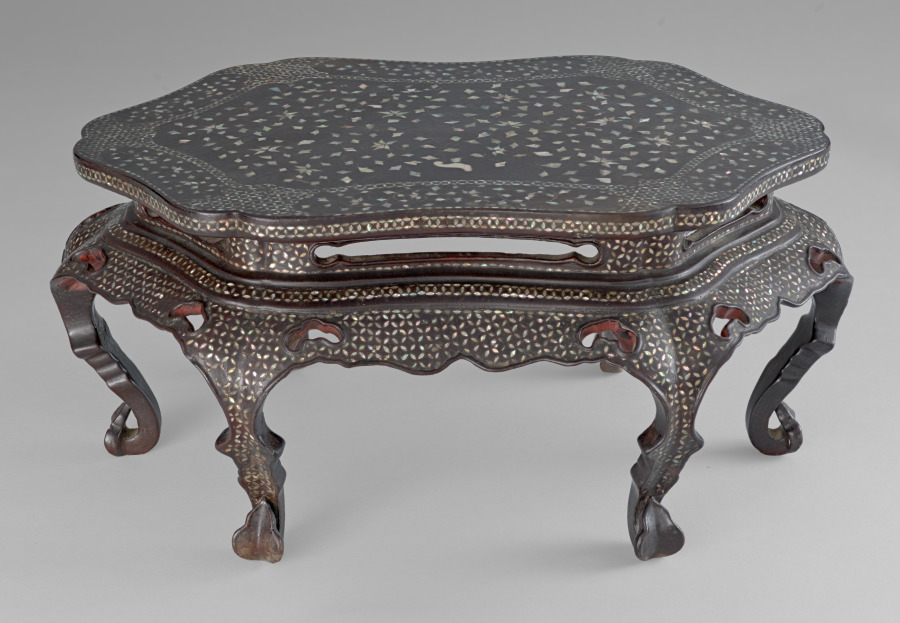
Hexafoil-Shaped Table with Mother-of-Pearl Inlay (late 1400s–early 1500s) is in the Cleveland Museum of Art collection.
The work and its context
The museum's open-access catalogue describes the work:
This low table showcases intricate mother-of-pearl and twisted brass-wire inlay forming chrysanthemum scrolls and floral lattices against black lacquer. As one of the few surviving early Joseon lacquer works employing the rare brass-wire technique, it reflects refined craftsmanship made for elite patrons. Likely used in Buddhist offering ceremonies, it would have supported precious ritual objects such as rolls of sutras or miniature Buddhist statuary.
Object facts
- Title: Hexafoil-Shaped Table with Mother-of-Pearl Inlay
- Date: late 1400s–early 1500s
- Culture: Korea, Joseon dynasty (1392–1910)
- Type: Lacquer
- Technique: Inlaid abalone shells on black lacquer ground, applied with red lacquer on the interior
- Dimensions: 42.5 x 26.4 x 20.6 cm (16 3/4 x 10 3/8 x 8 1/8 in.)
- Collection: Korean Art
- Department: Korean Art
- Accession number: 2026.4
A detail from the museum
The use of inlaid twisted brass wires in this mother-of-pearl lacquer table was first introduced in the twelfth century and is believed to have been employed in high-quality lacquerware through the end of the fifteenth century.
Collection credit
Sundry Art - Miscellaneous Fund
Further reading listed by the museum
- Hwang, Chi-hyŏn 황 지현 and Sadamu Kawada 河 田貞. Korean Lacquerware Inlaid with Mother-of-Pearl: The Everlasting Beauty. First edition. Seoul: National Museum of Korea, 2010.
- Korean Lacquer Art: Aesthetic Perfection. Münster, Munich: Museum für Lackkunst; Hirmer Verlag, 2012.
View the collection record
See the museum's photographs and full catalogue entry. Catalogue text is reproduced from the Cleveland Museum of Art's open-access data, with HTML formatting removed. This object and its supplied image are designated CC0.
Sources
More in Lifestyle
Keep reading