Horse Race at the Kamo Shrine (early to mid-1600s): Art, History and Details
Horse Race at the Kamo Shrine at the Cleveland Museum of Art: early to mid-1600s, Pair of six-panel folding screens; ink and color on gilded paper. Explore the work's context, creator attribution and collection history.
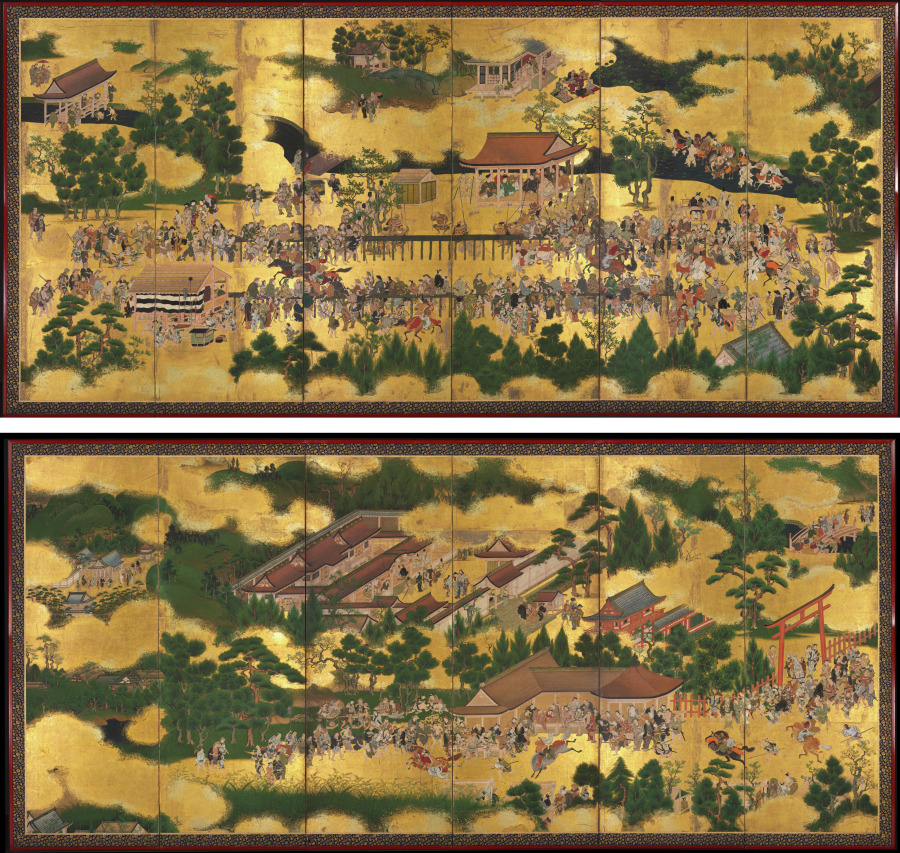
Horse Race at the Kamo Shrine (early to mid-1600s) is in the Cleveland Museum of Art collection.
The work and its context
The museum's open-access catalogue describes the work:
Here nearly 600 figures, engaged in a bewildering array of activities, have gathered at the Kamo Shrine in Kyoto for the horse race held annually on May 5 since at least the 800s. The entire populace seems to have turned out, apparent in the diversions and revelries spread out across these resplendent byøbu. The race begins on the right screen and continues far into the left along the lower half of the composition. Here the painter's genius for depicting engaging crowd scenes, a characteristic of Heian pictorial compositions, emerges in full force. The range of textile patterns alone is astonishing. The upper regions of the composition feature the shrine, its setting in northern Kyoto west of Lake Takaragaike, its architecture, and the visitors whose intentions range from casually mundane to spiritual. These paintings were originally part of a much larger pictorial narrative of linked murals in fusuma-e format. Four segments are known today from what must have been an extraordinary room of contiguous surfaces, executed by studio-trained but anonymous masters of yamato-e genre painting in Kyoto. The scale of the paintings and the quality of the materials indicate that they were commissioned by a sophisticated, wealthy patron.
Object facts
- Title: Horse Race at the Kamo Shrine
- Date: early to mid-1600s
- Culture: Japan, Edo period (1615–1868)
- Type: Painting
- Technique: Pair of six-panel folding screens; ink and color on gilded paper
- Dimensions: Image: 161 x 362 cm (63 3/8 x 142 1/2 in.)
- Collection: ASIAN - Folding screen
- Department: Japanese Art
- Accession number: 1976.95
A detail from the museum
The winner is decided by the distance between horses, not by which horse finished first.
Collection credit
Purchase from the J. H. Wade Fund
Further reading listed by the museum
- Lee, Sherman E. “Horse Racing at Kamo Shrine.” The Bulletin of the Cleveland Museum of Art 64, no. 8 (October 1977): 253–275.
- The Cleveland Museum of Art. Handbook of the Cleveland Museum of Art/1978. Cleveland, OH: The Cleveland Museum of Art, 1978.
- Lee, Sherman E., Michael R. Cunningham, and Ursula Korneitchouk. One Thousand Years of Japanese Art (650-1650): From the Cleveland Museum of Art: Catalogue. New York: Japan Society, 1981.
View the collection record
See the museum's photographs and full catalogue entry. Catalogue text is reproduced from the Cleveland Museum of Art's open-access data, with HTML formatting removed. This object and its supplied image are designated CC0.
Sources
More in Lifestyle
Keep reading