Incense Burner (100s BCE): Art, History and Details
Incense Burner at the Cleveland Museum of Art: 100s BCE, bronze. Explore the work's context, creator attribution and collection history.
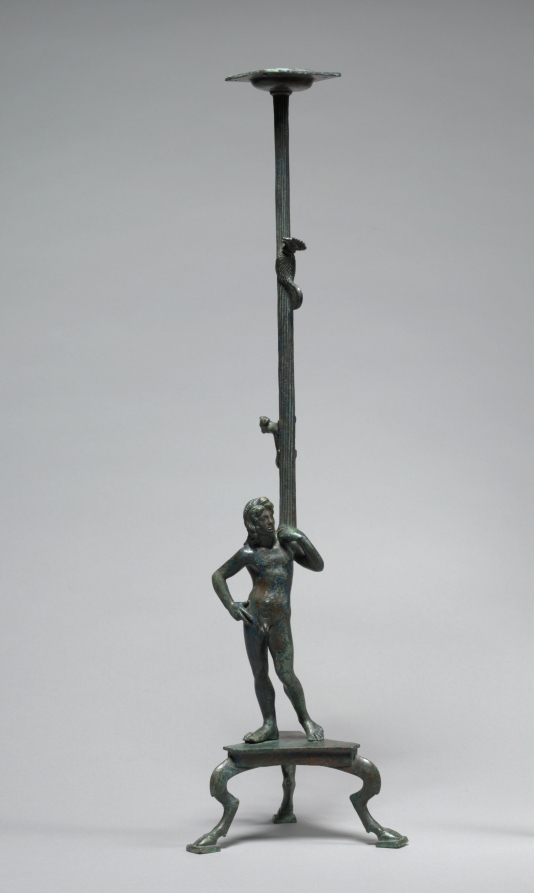
Incense Burner (100s BCE) is in the Cleveland Museum of Art collection.
The work and its context
The museum's open-access catalogue describes the work:
Both elaborate and functional, the Etruscan thymiaterion, or incense burner, typically comprises at least three main parts—tripod stand, shaft, and, at the top, a shallow bowl for incense. Often, a figural support is incorporated, here in the form of a youthful male nude, perhaps the wine god Dionysos. Below him, the tripod stand features cloven hoofs, while above him a spotted cat or panther climbs toward a rooster or other crested bird. Holes in each corner of the square upper plate likely held additional animals or other ornaments.
Object facts
- Title: Incense Burner
- Date: 100s BCE
- Culture: Etruscan
- Type: Metalwork
- Technique: bronze
- Dimensions: Overall: 61 cm (24 in.)
- Collection: GR - Etruscan
- Department: Greek and Roman Art
- Accession number: 1952.96
A detail from the museum
The circular depression on the top of this object likely held incense.
Collection credit
John L. Severance Fund
Further reading listed by the museum
- The Cleveland Museum of Art. Handbook of the Cleveland Museum of Art/1966. Cleveland, OH: The Cleveland Museum of Art, 1966.
- The Cleveland Museum of Art. Handbook of the Cleveland Museum of Art/1969. Cleveland, OH: The Cleveland Museum of Art, 1969.
- Cooney, John D. “A Miscellany of Ancient Bronzes.” The Bulletin of the Cleveland Museum of Art 58, no. 7 (1971): 210–18.
View the collection record
See the museum's photographs and full catalogue entry. Catalogue text is reproduced from the Cleveland Museum of Art's open-access data, with HTML formatting removed. This object and its supplied image are designated CC0.
Sources
More in Lifestyle
Keep reading