Inlay: Head of a King (380–246 BCE): Art, History and Details
Inlay: Head of a King at the Cleveland Museum of Art: 380–246 BCE, red jasper. Explore the work's context, creator attribution and collection history.
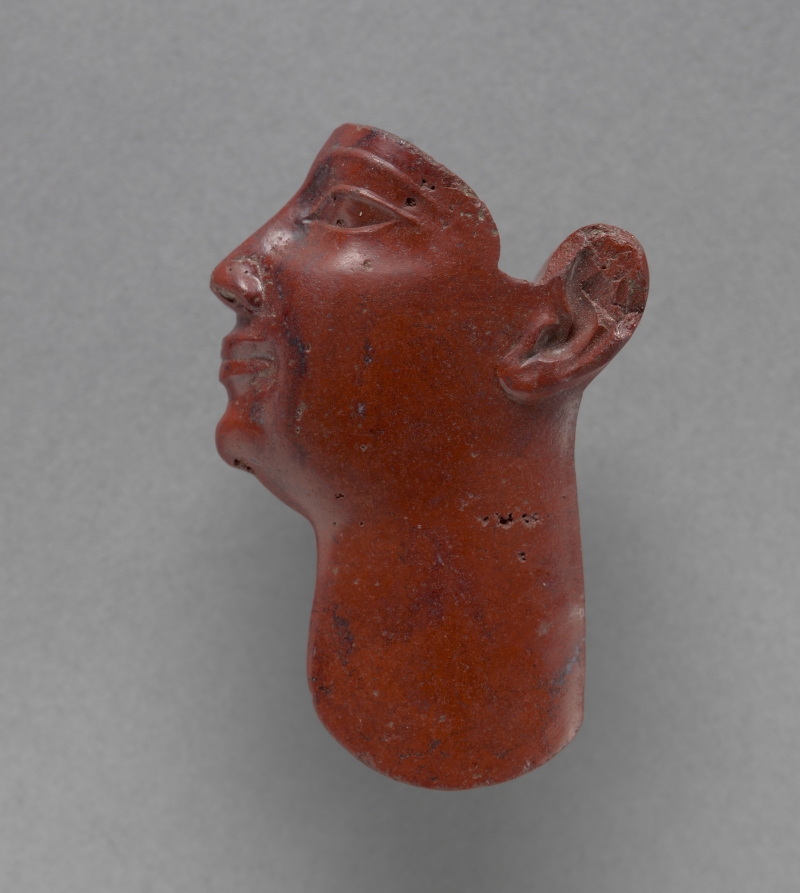
Inlay: Head of a King (380–246 BCE) is in the Cleveland Museum of Art collection.
The work and its context
The museum's open-access catalogue describes the work:
This miniature carved stone profile depicts a left-facing Egyptian king. The inlay was once part of a larger scene, with a cutaway on the king’s head clearly leaving room for an Egyptian crown and the neckline for a traditional broad collar. It is skillfully carved and made from red jasper, a semiprecious stone. The naturalistic handling of the cheeks and mouth date this inlay to the Ptolemaic period. An inlay such as this would have been set into a chest, throne, or even a royal coffin.
Object facts
- Title: Inlay: Head of a King
- Date: 380–246 BCE
- Culture: Egypt, Greco-Roman period (332 BCE–395 CE), Ptolemaic dynasty (305–30 BCE)
- Type: Glyptic
- Technique: red jasper
- Dimensions: Overall: 4.4 x 3.2 x 1.8 cm (1 3/4 x 1 1/4 x 11/16 in.)
- Collection: Egypt - Ptolemaic Dynasty
- Department: Egyptian and Ancient Near Eastern Art
- Accession number: 1966.370
A detail from the museum
Most Egyptian inlays are made of glass or faience, a type of ceramic, not precious or semiprecious stone like jasper.
Collection credit
James Parmelee Fund
Further reading listed by the museum
- “Annual Report for 1966.” The Bulletin of the Cleveland Museum of Art 54, no. 6 (1967): 159–97.
- “Recent Important Acquisitions: MADE BY PUBLIC AND PRIVATE COLLECTIONS IN THE UNITED STATES AND ABROAD.” Journal of Glass Studies 10 (1968): 180–90.
- Cooney, John D. “Intaglios, Cameos, and Related Works.” The Bulletin of the Cleveland Museum of Art 55, no. 4 (April 1968): 113–119.
View the collection record
See the museum's photographs and full catalogue entry. Catalogue text is reproduced from the Cleveland Museum of Art's open-access data, with HTML formatting removed. This object and its supplied image are designated CC0.
Sources
More in Lifestyle
Keep reading