Jacket with Octopus (c. 1800–1868): Art, History and Details
Jacket with Octopus at the Cleveland Museum of Art: c. 1800–1868, Silk crepe (chirimen). Explore the work's context, creator attribution and collection history.
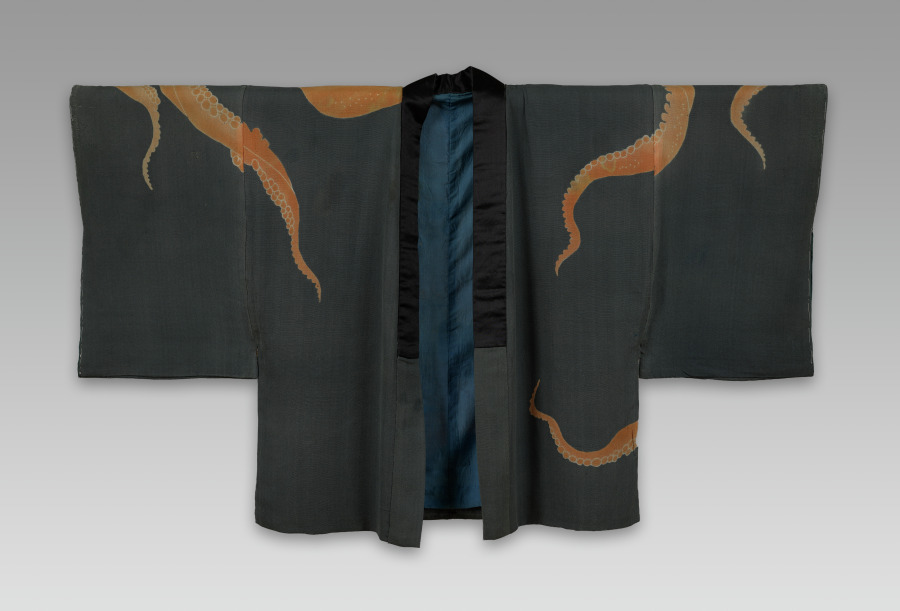
Jacket with Octopus (c. 1800–1868) is in the Cleveland Museum of Art collection.
The work and its context
The museum's open-access catalogue describes the work:
With its many long arms, the octopus lends itself to a tantalizing design, with the front of this garment displaying tentacles and the back revealing the face. An octopus motif sometimes appears on costumes for the role of the Catfish Priest, a sidekick of the main villain in the Kabuki play Shibaraku (Stop a Moment!). It is also seen in genre painting during the 1600s as a logo on the uniforms of transportation staff, perhaps indicating just how much they can carry. This jacket may have recycled the idea as a fashion statement.
Object facts
- Title: Jacket with Octopus
- Date: c. 1800–1868
- Culture: Japan, Edo period (1615–1868)
- Type: Textile
- Technique: Silk crepe (chirimen)
- Dimensions: neck edge to hem: 79.1 cm (31 1/8 in.); Across shoulders: 128.6 cm (50 5/8 in.)
- Collection: Japanese Art
- Department: Japanese Art
- Accession number: 2020.66
A detail from the museum
Crepe results from the weft thread being kept tighter than the warp thread during weaving.
Collection credit
L. E. Holden Fund
Further reading listed by the museum
- Yamanaka, Norio. The Book of Kimono. New York: Kodansha USA, 2012.
- Lynch, Annette, and Mitchell D. Strauss. Ethnic Dress in the United States: A Cultural Encyclopedia. Lanham: Rowman & Littlefield, 2015.
- Permanent Collection Installations.” Cleveland Art: Cleveland Museum of Art Members Magazine 63, no. 3 (2023): 12–13.
View the collection record
See the museum's photographs and full catalogue entry. Catalogue text is reproduced from the Cleveland Museum of Art's open-access data, with HTML formatting removed. This object and its supplied image are designated CC0.
Sources
More in Lifestyle
Keep reading