Janiform Head Flask (100–400 CE): Art, History and Details
Janiform Head Flask at the Cleveland Museum of Art: 100–400 CE, glass, mold-blown. Explore the work's context, creator attribution and collection history.
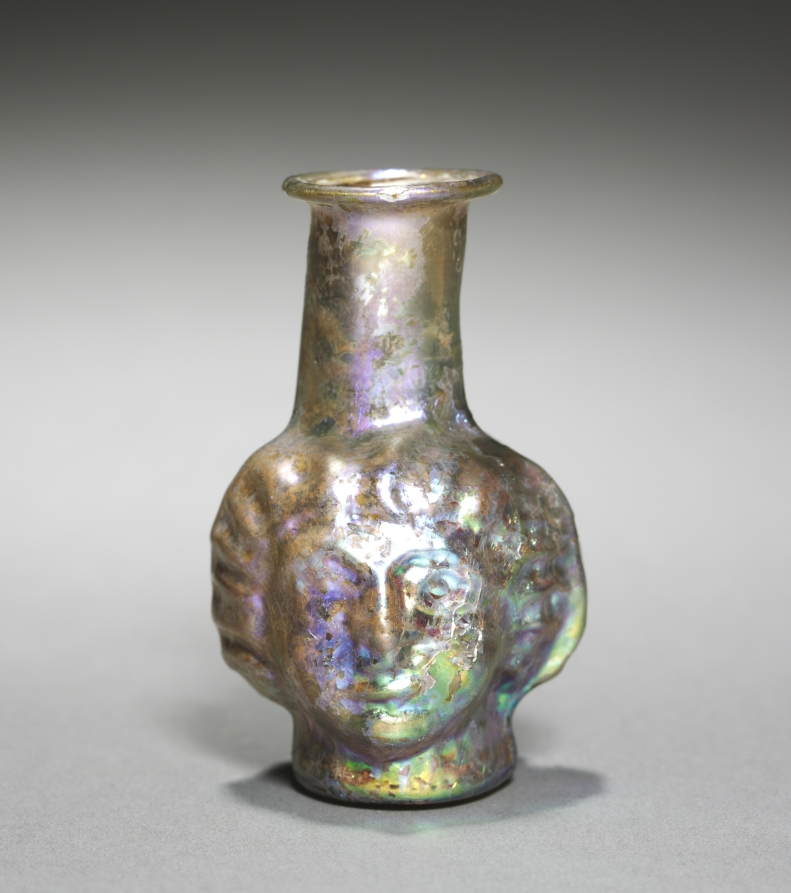
Janiform Head Flask (100–400 CE) is in the Cleveland Museum of Art collection.
The work and its context
The museum's open-access catalogue describes the work:
Called Janiform after Janus, the two-faced Roman god associated with doorways and beginnings, two-faced head flasks like this were popular across the Roman Empire. The faces themselves, quite similar to one another, could both represent Janus, although he is typically bearded and here the gender is unclear. Some other two-faced head flasks clearly differentiate between the two sides, showing one serious, the other smiling.
Object facts
- Title: Janiform Head Flask
- Date: 100–400 CE
- Culture: Roman, probably Eastern Mediterranean
- Type: Glass
- Technique: glass, mold-blown
- Dimensions: Diameter: 4.6 cm (1 13/16 in.); Overall: 6.4 cm (2 1/2 in.)
- Collection: GR - Roman
- Department: Greek and Roman Art
- Accession number: 1923.945
A detail from the museum
The iridescence covering much of the surface obscures the original violet-like color.
Collection credit
Gift of J. H. Wade
View the collection record
See the museum's photographs and full catalogue entry. Catalogue text is reproduced from the Cleveland Museum of Art's open-access data, with HTML formatting removed. This object and its supplied image are designated CC0.
Sources
More in Lifestyle
Keep reading