Jar-shaped Basket (1910): Art, History and Details
Jar-shaped Basket at the Cleveland Museum of Art: 1910, Willow, bulrush; coiled (3 rods). Explore the work's context, creator attribution and collection history.
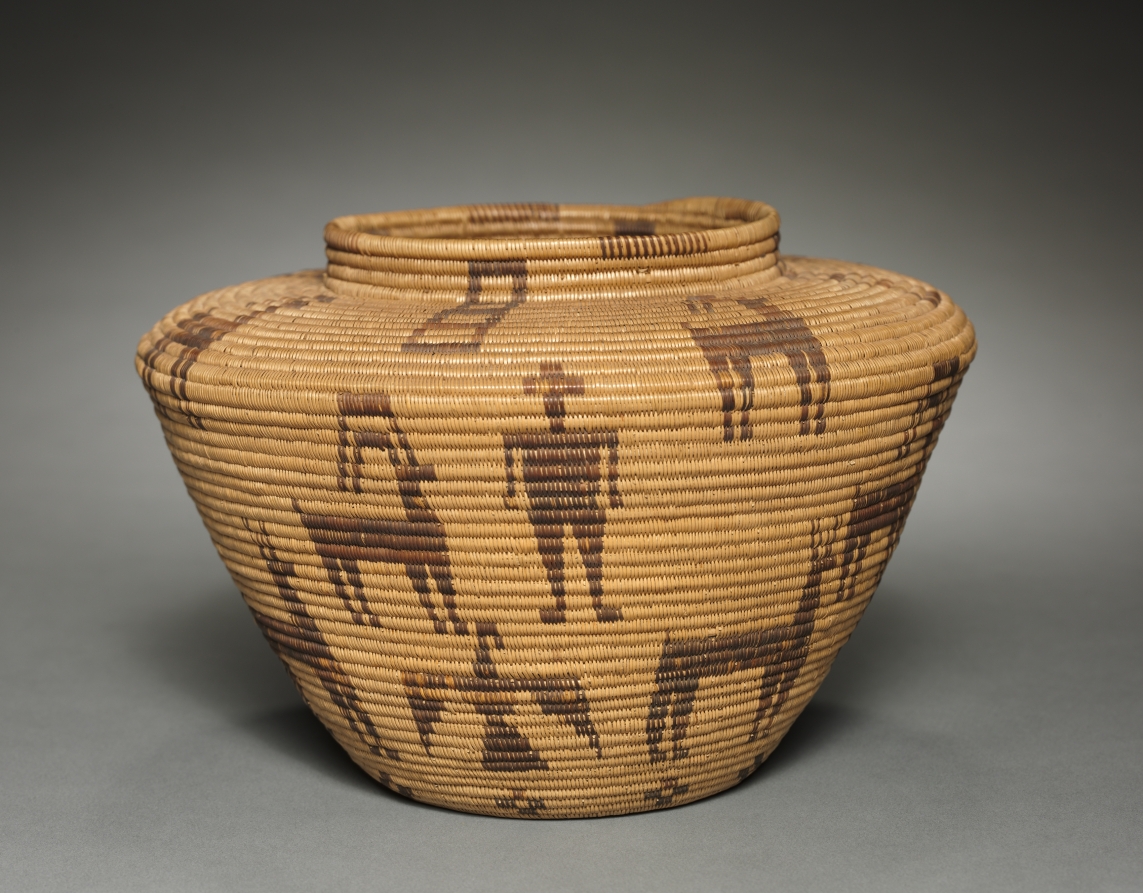
Jar-shaped Basket (1910) is in the Cleveland Museum of Art collection. The museum's creator attribution is Sarah Hunter (Timbisha Shoshone (Panamint), 1883–1967).
The work and its context
The museum's open-access catalogue describes the work:
Sarah Hunter’s basketry is noted for geometricized motifs reminiscent of the animals depicted in petroglyphs on canyon walls in the Death Valley region. Here they include pronghorn mountain sheep, deer, and birds, along with humans, all created in light-brown bulrush against a honey-colored willow ground. Traditional Indigenous basket weavers, who have exhaustive knowledge of the plant world, tend, harvest, and prepare their own materials. If stages of the process are not done properly and at the right time, color will be uneven and stitches will twist and split.
Object facts
- Title: Jar-shaped Basket
- Date: 1910
- Creator attribution: Sarah Hunter (Timbisha Shoshone (Panamint), 1883–1967)
- Culture: Native North America, Great Basin, California, Death Valley
- Type: Basketry
- Technique: Willow, bulrush; coiled (3 rods)
- Dimensions: Overall: 12.5 x 18.5 cm (4 15/16 x 7 5/16 in.)
- Collection: AA - Native North America
- Department: Art of the Americas
- Accession number: 1917.454
A detail from the museum
Some Timbisha Shoshone women continue traditions of basket weaving to the present day.
Collection credit
Presented by William Albert Price in memory of Mrs. William Albert Price
Further reading listed by the museum
- "Accessions." The Bulletin of the Cleveland Museum of Art 4, no. 4 (1917): 64-67.
View the collection record
See the museum's photographs and full catalogue entry. Catalogue text is reproduced from the Cleveland Museum of Art's open-access data, with HTML formatting removed. This object and its supplied image are designated CC0.
Sources
More in Lifestyle
Keep reading


