Jar with Scroll Design (1400s): Art, History and Details
Jar with Scroll Design at the Cleveland Museum of Art: 1400s, Buncheong ware with incised, stamped, and slip-inlaid decoration. Explore the work's context, creator attribution and collection history.
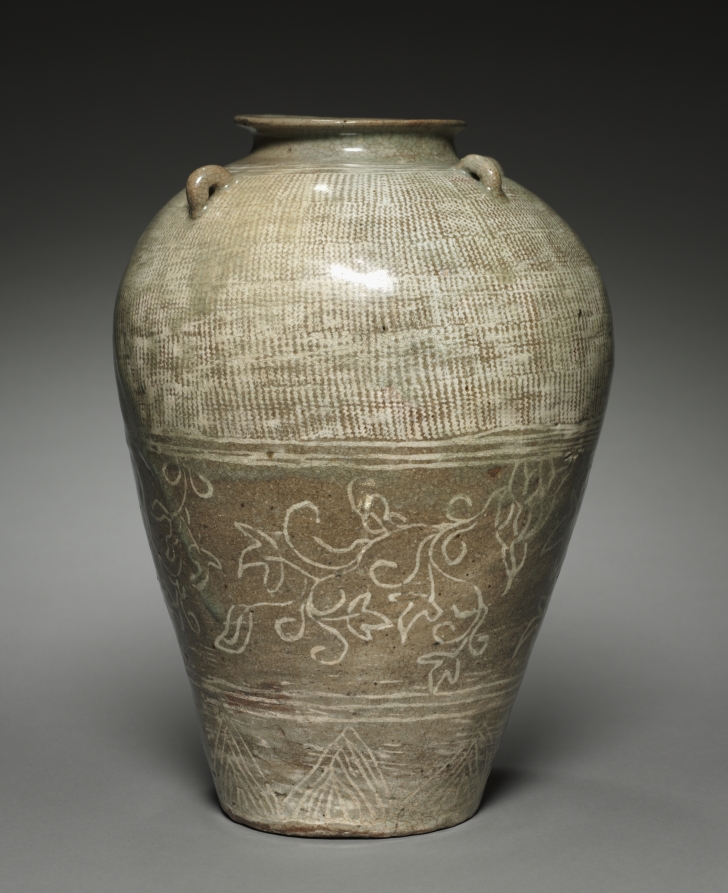
Jar with Scroll Design (1400s) is in the Cleveland Museum of Art collection.
The work and its context
The museum's open-access catalogue describes the work:
In premodern Korea, a newborn baby’s umbilical cord and placenta were believed to be a symbol of the life force of the fetus and thus kept in a specially arranged burial site. This jar was made exclusively for burying a placenta, a custom practiced by aristocratic families in Korea in the belief that it would bring happiness to the child.
Object facts
- Title: Jar with Scroll Design
- Date: 1400s
- Culture: Korea, Joseon dynasty (1392–1910)
- Type: Ceramic
- Technique: Buncheong ware with incised, stamped, and slip-inlaid decoration
- Dimensions: height: 37.6 cm (14 13/16 in.); Outer diameter: 27 cm (10 5/8 in.)
- Collection: Korean Art
- Department: Korean Art
- Accession number: 1963.505
A detail from the museum
The tiny ear-like handles located around the jar's shoulder allowing string to pass through were used to keep the lid (now missing) tightly closed.
Collection credit
John L. Severance Fund
Further reading listed by the museum
- Treasures from Korea: Arts and Culture of the Joseon Dynasty, 1392-1910. Philadelphia: Philadelphia Museum of Art, 2014.
- The Cleveland Museum of Art. Handbook of the Cleveland Museum of Art/1978. Cleveland, OH: The Cleveland Museum of Art, 1978.
- Cleveland Museum of Art, and Jenifer Neils. The World of Ceramics: Masterpieces from the Cleveland Museum of Art. Cleveland: Museum in cooperation with Indiana University Press, 1982.
View the collection record
See the museum's photographs and full catalogue entry. Catalogue text is reproduced from the Cleveland Museum of Art's open-access data, with HTML formatting removed. This object and its supplied image are designated CC0.
Sources
More in Lifestyle
Keep reading
Related stories