Kirwuttee, A Temple, India (c. 1857): Art, History and Details
Kirwuttee, A Temple, India at the Cleveland Museum of Art: c. 1857, albumen print from paper negative. Explore the work's context, creator attribution and collection history.
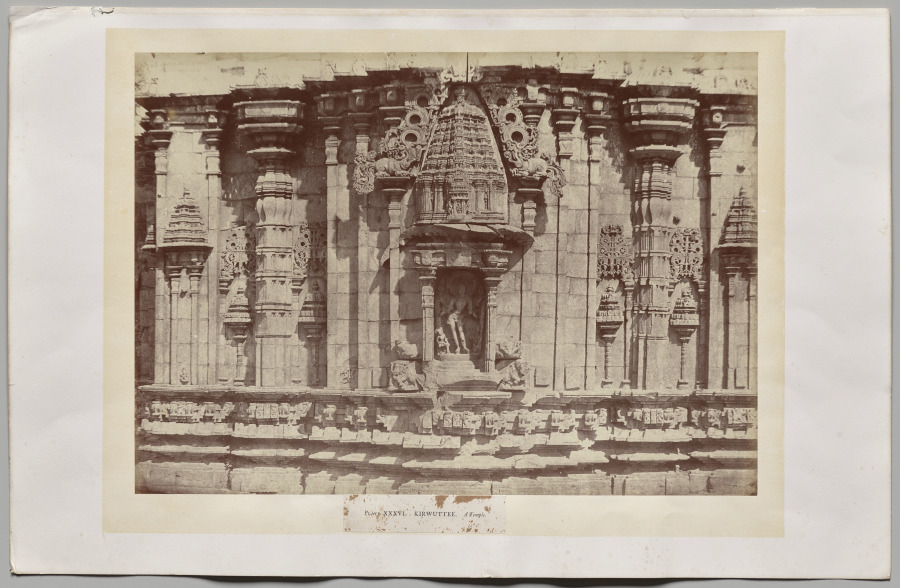
Kirwuttee, A Temple, India (c. 1857) is in the Cleveland Museum of Art collection. The museum's creator attribution is William Henry Pigou (British, 1818–1858).
The work and its context
The museum's open-access catalogue describes the work:
William Henry Pigou, a medical doctor who was an amateur photographer, spent 1856–57 working for the British colonial government recording ancient Indian monuments. This image of the temple at Kirwuttee (current accepted spelling is Kuruvatti) was taken around two years after the introduction of photography to India. This building primarily has miniature temple models as its exterior ornamentation in combination with only a few figural sculptures.
Object facts
- Title: Kirwuttee, A Temple, India
- Date: c. 1857
- Creator attribution: William Henry Pigou (British, 1818–1858)
- Culture: England, 19th century
- Type: Photograph
- Technique: albumen print from paper negative
- Dimensions: Image: 27.6 x 38.9 cm (10 7/8 x 15 5/16 in.); Image with border: 31.6 x 42.6 cm (12 7/16 x 16 3/4 in.); Paper: 35.7 x 55 cm (14 1/16 x 21 5/8 in.)
- Collection: PH - British 19th Century
- Department: Photography
- Accession number: 2019.54
Collection credit
Photography Discretionary Fund
Further reading listed by the museum
- Meadows Taylor, et al. Architecture in Dharwar and Mysore. Photographed by ... Dr. Pigou ... A.c.b. Neill ... and Colonel Biggs. ... with an Historical and Descriptive Memoir by ... M. Taylor ... and Architectural Notes by J. Fergusson, Etc. 1866.
View the collection record
See the museum's photographs and full catalogue entry. Catalogue text is reproduced from the Cleveland Museum of Art's open-access data, with HTML formatting removed. This object and its supplied image are designated CC0.
Sources
More in Lifestyle
Keep reading