Koto from the series The Six Arts in Fashionable Guise (c. 1793–96): Art, History and Details
Koto from the series The Six Arts in Fashionable Guise at the Cleveland Museum of Art: c. 1793–96, Color woodblock print; ink and color on paper. Explore the work's context, creator attribution and collection history.
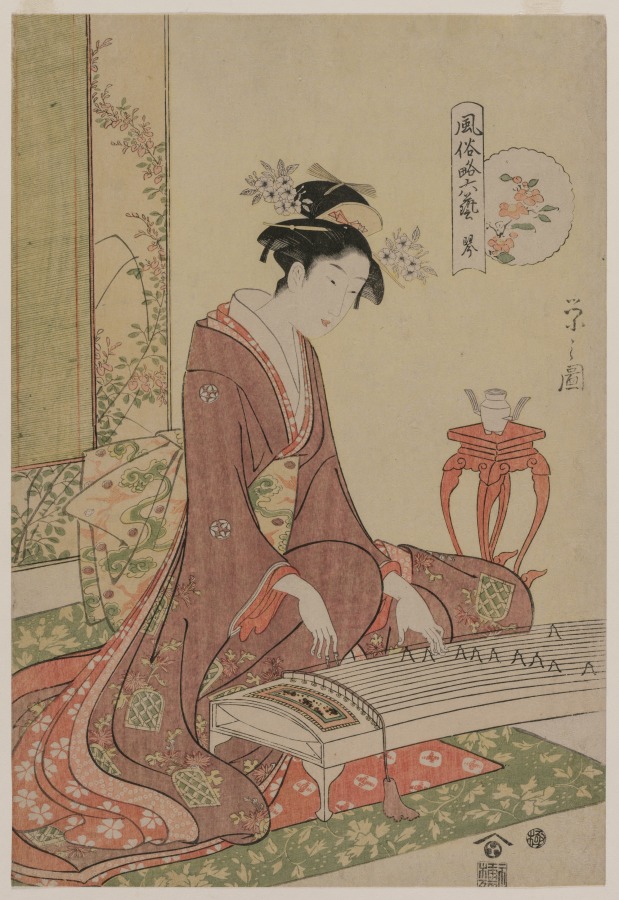
Koto from the series The Six Arts in Fashionable Guise (c. 1793–96) is in the Cleveland Museum of Art collection. The museum's creator attribution is Chōbunsai Eishi (Japanese, 1756–1829).
The work and its context
The museum's open-access catalogue describes the work:
Chinese classical education consisted of the Six Arts: performing rites, music, archery, charioteering, calligraphy, and mathematics. The Chinese qin, a stringed musical instrument in the zither family, customarily symbolizes the art of music. In this print a similar Japanese instrument, the koto, replaces the qin. The fashionable Japanese entertainer playing it stands in for an accomplished Chinese scholar.
Object facts
- Title: Koto from the series The Six Arts in Fashionable Guise
- Date: c. 1793–96
- Creator attribution: Chōbunsai Eishi (Japanese, 1756–1829)
- Culture: Japan, Edo period (1615–1868)
- Type: Print
- Technique: Color woodblock print; ink and color on paper
- Dimensions: Sheet: 36.6 x 25 cm (14 7/16 x 9 13/16 in.)
- Collection: Japanese Art
- Department: Japanese Art
- Accession number: 1985.301
Collection credit
The Kelvin Smith Collection, given by Mrs. Kelvin Smith
Further reading listed by the museum
- Lee, Sherman E. “A. Kelvin Smith (1899-1984): Collector.” The Bulletin of the Cleveland Museum of Art 75, no. 7 (September 1988): 240–243.
View the collection record
See the museum's photographs and full catalogue entry. Catalogue text is reproduced from the Cleveland Museum of Art's open-access data, with HTML formatting removed. This object and its supplied image are designated CC0.
Sources
More in Lifestyle
Keep reading