Mother Goddess (c. 600): Art, History and Details
Mother Goddess at the Cleveland Museum of Art: c. 600, schist. Explore the work's context, creator attribution and collection history.
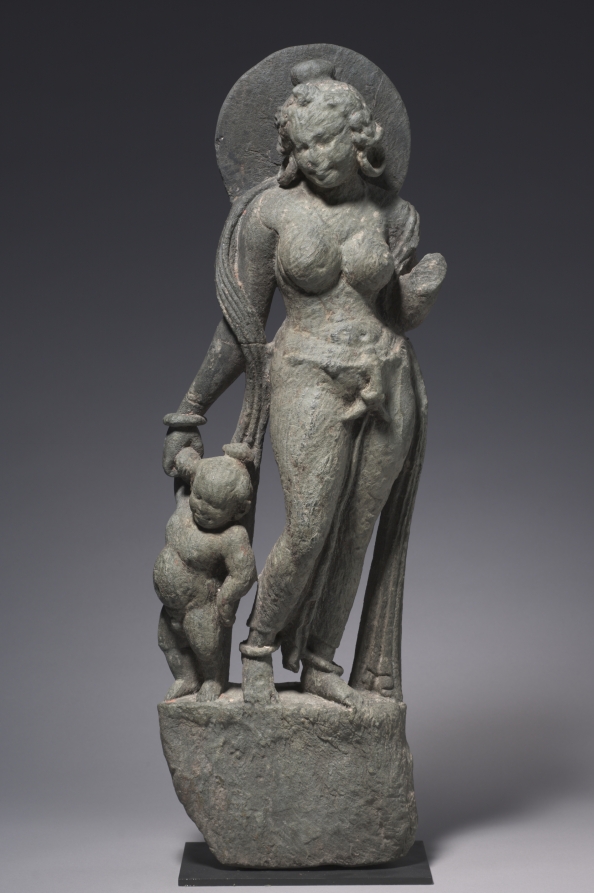
Mother Goddess (c. 600) is in the Cleveland Museum of Art collection.
The work and its context
The museum's open-access catalogue describes the work:
Sets of mother goddesses were installed in shrines near the entrance to Hindu temples. From one of the most naturalistic and charming sets, this mother attentively grasps the wrist of her toddler to gently guide him, while smiling lovingly and patiently at him. The simplicity of garments and ornament is characteristic of sculpture of the sixth century, and the naturalistic qualities of this work from northwestern India suggest connections with the Greco-Roman styles of Gandhara, in present-day Pakistan.
Object facts
- Title: Mother Goddess
- Date: c. 600
- Culture: Northwestern India, Rajasthan, Udaipur District
- Type: Sculpture
- Technique: schist
- Dimensions: Overall: 79.4 x 23.2 cm (31 1/4 x 9 1/8 in.)
- Collection: Indian Art
- Department: Indian and Southeast Asian Art
- Accession number: 1970.12
A detail from the museum
This sculpture was one of twelve that were brought to a modern temple known as the Tanesar (Thaneshvara) Mahadeva Temple.
Collection credit
Purchase from the J. H. Wade Fund
Further reading listed by the museum
- Agrawala, R. C. “Some More Unpublished Sculptures from Rajasthan.” Lalit Kala, No. 10 (October 1961).
- Lee, Sherman E. "The Year in Review for 1970." The Bulletin of the Cleveland Museum of Art 58, no. 2 (1971): 22-71.
- Pal, Pratapaditya. “Some Rajasthani Sculptures of the Gupta Period”, Allen Memorial Art Museum Bulletin, Oberlin College (Winter 1971), pp. 105-118.
View the collection record
See the museum's photographs and full catalogue entry. Catalogue text is reproduced from the Cleveland Museum of Art's open-access data, with HTML formatting removed. This object and its supplied image are designated CC0.
Sources
More in Lifestyle
Keep reading