Krishna Playing with the Gopis in the Yamuna (c. 1770): Art, History and Details
Krishna Playing with the Gopis in the Yamuna at the Cleveland Museum of Art: c. 1770, gum tempera and gold on paper. Explore the work's context, creator attribution and collection history.
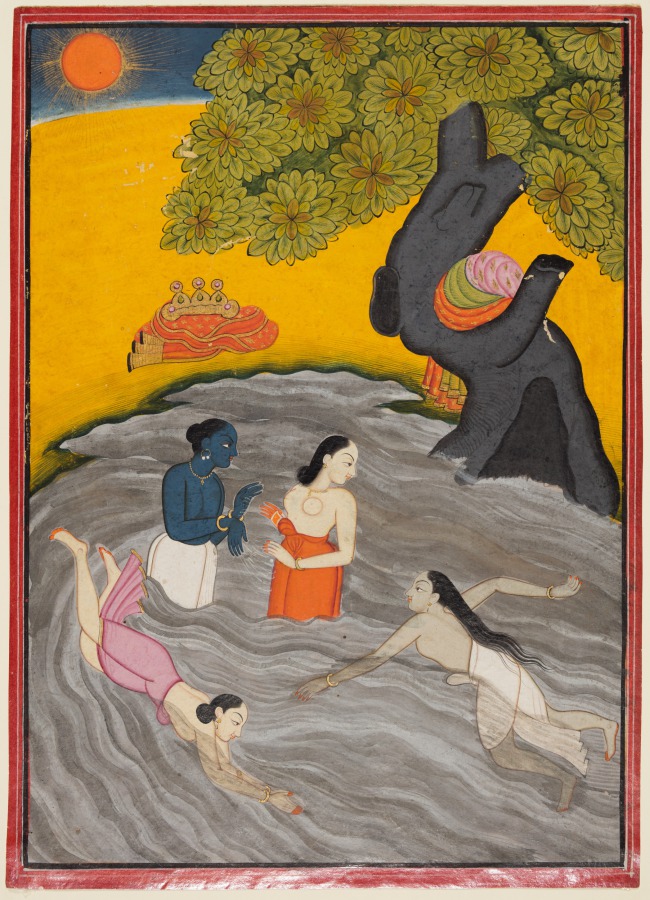
Krishna Playing with the Gopis in the Yamuna (c. 1770) is in the Cleveland Museum of Art collection.
The work and its context
The museum's open-access catalogue describes the work:
After Krishna raised Mount Govardhan, he began to play erotically with the girls of his village. Under a scorching sun, Krishna and three milkmaids enjoy the cooling waters of the Yamuna River. The women neatly stack their clothes on a nearby tree, and Krishna’s crown and scarf rest by the bank. Krishna playfully splashes one of the women, and she turns her face away. This scene evokes the joy of spending life in intimacy with the god Krishna.
Object facts
- Title: Krishna Playing with the Gopis in the Yamuna
- Date: c. 1770
- Culture: Northern India, Pahari kingdoms
- Type: Painting
- Technique: gum tempera and gold on paper
- Dimensions: Page: 24.8 x 17.8 cm (9 3/4 x 7 in.); Image: 23.5 x 16.6 cm (9 1/4 x 6 9/16 in.)
- Collection: Indian Art
- Department: Indian and Southeast Asian Art
- Accession number: 2018.118
A detail from the museum
Krishna playfully splashes one of the women who turns her face away.
Collection credit
Purchase and partial gift from the Catherine and Ralph Benkaim Collection; Severance and Greta Millikin Purchase Fund
Further reading listed by the museum
- Griswold, William, Cameron Kitchin, Chase F. Robinson, Cleveland Museum of Art, Cincinnati Art Museum, and National Museum of Asian Art (Smithsonian Institution). Pahari Paintings: Art and Stories, edited by Sonya Rhie Mace, Sarang Sharma, and Vijay Sharma. Cleveland, Ohio: Cleveland Museum of Art, 2026.
- “Longing: Painting from the Pahari Kingdoms of the Northwest Himalayas.” The Asian Art Newspaper 29, i. 3 (March 2026): 22.
- Cameron, Ainsley M. “Considering Painting from the Pahari Kingdoms through Sight, Sound, Smell and Touch.” Arts of Asia, (Spring 2026): 79-91.
View the collection record
See the museum's photographs and full catalogue entry. Catalogue text is reproduced from the Cleveland Museum of Art's open-access data, with HTML formatting removed. This object and its supplied image are designated CC0.
Sources
More in Lifestyle
Keep reading