Lampas with phoenixes amid undulating vines (late 1200s-1300s): Art, History and Details
Lampas with phoenixes amid undulating vines at the Cleveland Museum of Art: late 1200s-1300s, lampas: silk, cotton, and gold thread. Explore the work's context, creator attribution and collection history.
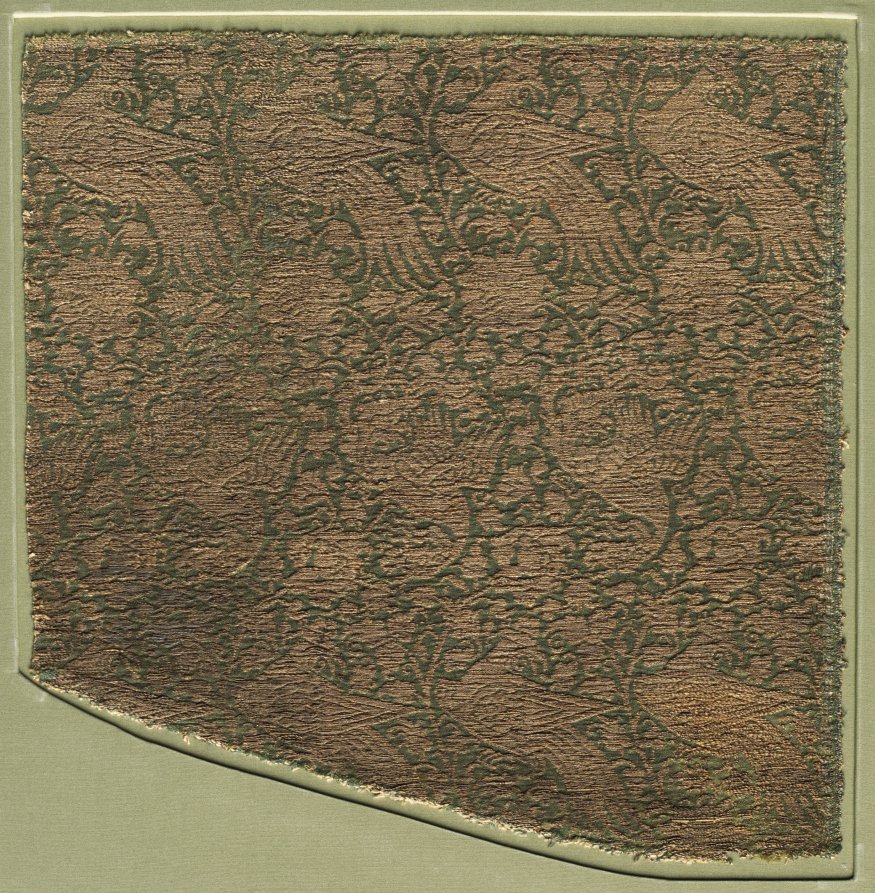
Lampas with phoenixes amid undulating vines (late 1200s-1300s) is in the Cleveland Museum of Art collection.
The work and its context
The museum's open-access catalogue describes the work:
The elegant design of standing or diving phoenixes among parallel, curving floral vines is based on Chinese textiles. The phoenixes are actually of two types (notice the difference in their tails). Their combination, probably an innovation of Yuan China (1279-1368), also appears on the embroidered canopy (cat. no. 60) in this exhibition. In the eastern Iranian world, Chinese motifs and patterns were incorporated into local designs beginning in the 1270s.
Object facts
- Title: Lampas with phoenixes amid undulating vines
- Date: late 1200s-1300s
- Culture: Eastern Iran, Ilkhanid period
- Type: Textile
- Technique: lampas: silk, cotton, and gold thread
- Dimensions: Overall: 43.5 x 39.5 cm (17 1/8 x 15 9/16 in.)
- Collection: T - Islamic
- Department: Textiles
- Accession number: 1985.4
Collection credit
Purchase from the J. H. Wade Fund
Further reading listed by the museum
- Wardwell, A. (1987). Flight of the Phoenix: Crosscurrents in Late Thirteenth- to Fourteenth-Century Silk Patterns and Motifs. The Bulletin of the Cleveland Museum of Art, 74(1), 2-35.
- Indictor, Norman, Robert J. (Robert John) Koestler, Christopher Blair, and Anne E. Wardwell. “The Evaluation of Metal Wrappings from Medieval Textiles Using Scanning Electron Microscopy-Energy Dispersive x-Ray Spectrometry.” Textile History 19 (1). 1988.
- Wardwell, Anne E. "Panni Tartarici: Eastern Islamic Silks Woven with Gold and Silver (13th and 14th Centuries)." In Islamic Art III, 95-173. New York: The Islamic Art Foundation, 1989.
View the collection record
See the museum's photographs and full catalogue entry. Catalogue text is reproduced from the Cleveland Museum of Art's open-access data, with HTML formatting removed. This object and its supplied image are designated CC0.
Sources
More in Lifestyle
Keep reading