Leaf from a Lectionary with St. Matthew (1057–1063): Art, History and Details
Leaf from a Lectionary with St. Matthew at the Cleveland Museum of Art: 1057–1063, tempera and gold on vellum. Explore the work's context, creator attribution and collection history.
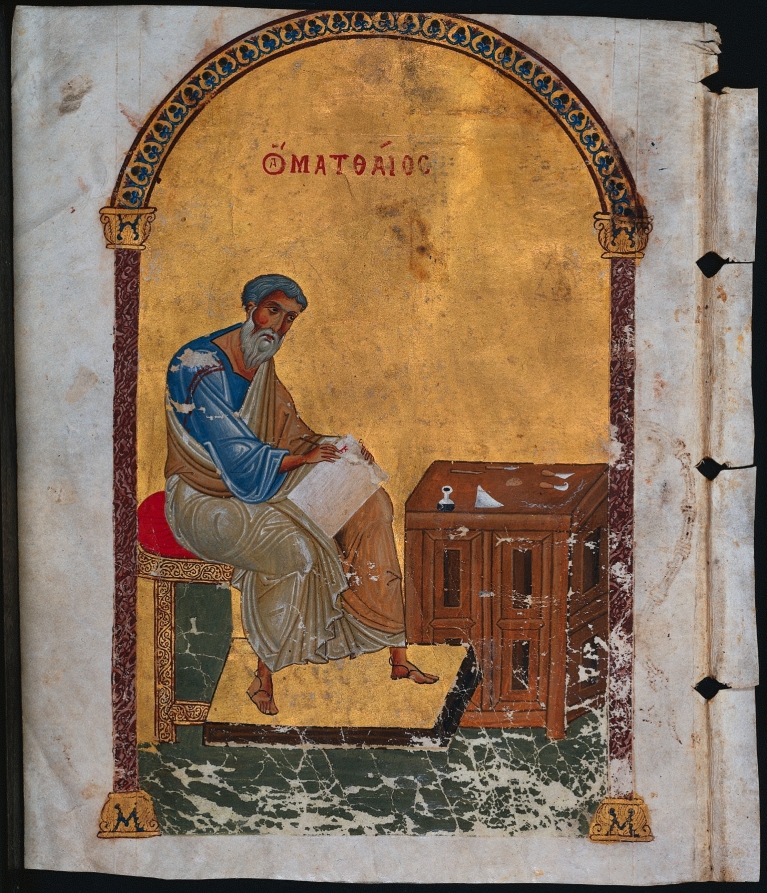
Leaf from a Lectionary with St. Matthew (1057–1063) is in the Cleveland Museum of Art collection.
The work and its context
The museum's open-access catalogue describes the work:
This leaf is from a lectionary (a book of gospel readings used in church services) that was presented to the Holy Trinity Monastery at Chalke in Constantinople by the Empress Katherine Komnene in 1063. The tools of the scribe's trade are laid out before the evangelists: a stylus (a pointed tool for writing, drawing, and engraving), a pair of dividers (a device resembling a compass, used for dividing lines and transferring measurements), pens, a knife, a burnisher (polishing tool), and inkpots. Portraits of the authors of the Gospels—Matthew, Mark, Luke, and John—appear frequently in gospel books throughout the Christian world. Understood to be eyewitnesses to the texts they wrote, their presence in these books served to "authenticate" the gospels.
Object facts
- Title: Leaf from a Lectionary with St. Matthew
- Date: 1057–1063
- Culture: Byzantium, Constantinople
- Type: Manuscript
- Technique: tempera and gold on vellum
- Dimensions: Sheet: 28.8 x 24.3 cm (11 5/16 x 9 9/16 in.); Framed: 52.4 x 39.7 cm (20 5/8 x 15 5/8 in.); Matted: 48.9 x 36.2 cm (19 1/4 x 14 1/4 in.)
- Collection: MED - Byzantine
- Department: Medieval Art
- Accession number: 1942.1512
A detail from the museum
Early Gospel lectionaries often had very costly treasure bindings in metalwork, sometimes with jewels and ivories.
Collection credit
Purchase from the J. H. Wade Fund
Further reading listed by the museum
- Charles Diehl. “L’Evengélaire de l’Impératice Catherine Commnène” Compte Rendu de Séances de l’Académie des Inscriptions et Belles Lettres (Paris, 1922)
- Diehl, Charles, “Monuments Byzantins Inédits du Onzième Siècle” Art Studies: Medieval, Renaissance and Modern. Cambridge: Harvard University Press, 1927.
- Clark, Kenneth W. A Descriptive Catalogue of Greek New Testament Manuscripts in America. 1937.
View the collection record
See the museum's photographs and full catalogue entry. Catalogue text is reproduced from the Cleveland Museum of Art's open-access data, with HTML formatting removed. This object and its supplied image are designated CC0.
Sources
More in Lifestyle
Keep reading