Leaving the Bath (1879–80): Art, History and Details
Leaving the Bath at the Cleveland Museum of Art: 1879–80, drypoint, aquatint. Explore the work's context, creator attribution and collection history.
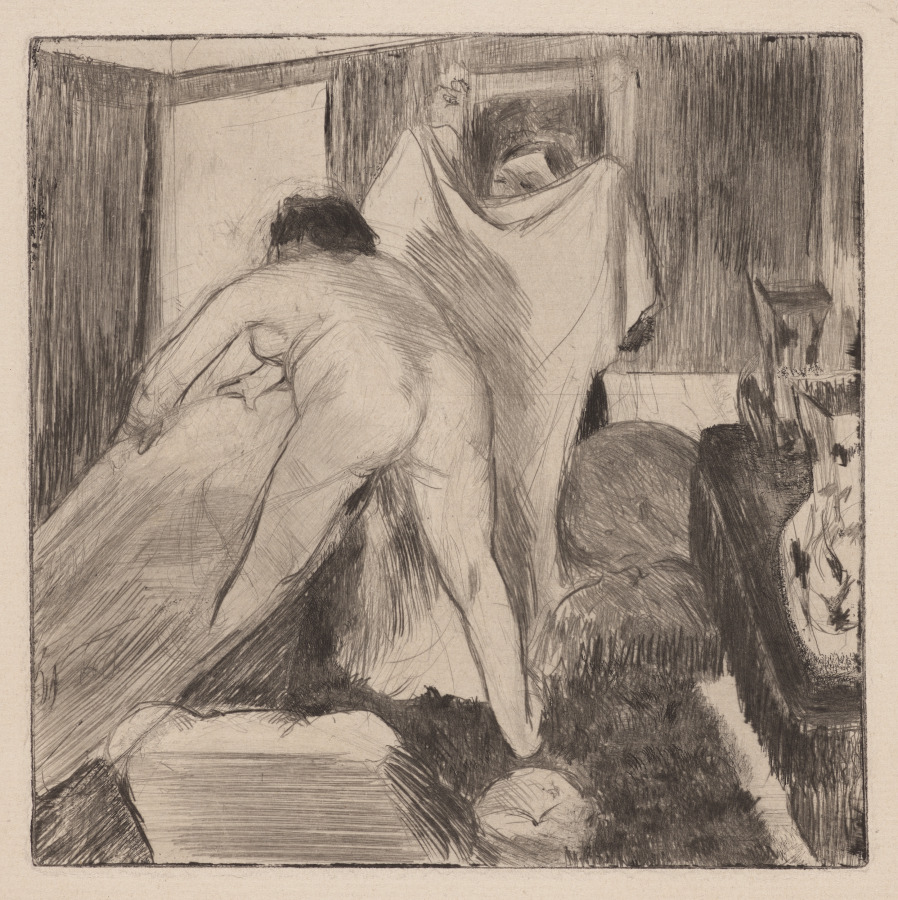
Leaving the Bath (1879–80) is in the Cleveland Museum of Art collection. The museum's creator attribution is Edgar Degas (French, 1834–1917).
The work and its context
The museum's open-access catalogue describes the work:
In Leaving the Bath, a woman is seen from behind as she awkwardly grips a tub while cautiously stepping out of it. Nearby, a maid is mostly obscured by a cloth meant to dry and warm her. Their sketchlike surroundings communicate intimacy and privacy and, in what would become a characteristic aspect of his bather imagery, Edgar Degas places the viewer in a voyeuristic perspective, with the two women unaware of our presence. The artist began to explore etching in the 1850s, registering in the print department of Paris’s Bibliothèque Nationale so that he could closely study the works of past masters such as Rembrandt van Rijn. Degas saw prints as having an important part to play in the Impressionists’ group exhibitions and displayed them alongside paintings there.
Object facts
- Title: Leaving the Bath
- Date: 1879–80
- Creator attribution: Edgar Degas (French, 1834–1917)
- Culture: France
- Type: Print
- Technique: drypoint, aquatint
- Dimensions: Image and Plate: 12.7 x 12.7 cm (5 x 5 in.); Sheet: 21.5 x 29.5 cm (8 7/16 x 11 5/8 in.)
- Collection: PR - Drypoint
- Department: Prints
- Accession number: 2025.198
A detail from the museum
Edgar Degas created this print by drawing on a copper plate, not with a traditional etching needle, but with a copper rod—a component of early electric lamps. This nontraditional tool produced an effect that Degas appreciated, and he experimented further after bringing the plate home by working on it with materials ranging from an emery pencil to a stone.
Collection credit
Alma Kroeger Fund
Further reading listed by the museum
- Galerie Manzi-Joyant (Paris, France). Eaux-Fortes, Vernis-Mous, Aqua-Tintes Par Edgar Degas et Provenant de Son Atelier., 1918.
- Galerie Kornfeld. Kunstwerke Des 19. Bis 21. Jahrhunderts, Teil II. Bern: Galerie Kornfeld, 2019.
- Degas, Edgar, Richard Kendall, Anthea Callen, Dillian Gordon, and Tate Gallery Liverpool. Degas, Images of Women. Millbank, London: Tate Gallery Publications, 1989.
View the collection record
See the museum's photographs and full catalogue entry. Catalogue text is reproduced from the Cleveland Museum of Art's open-access data, with HTML formatting removed. This object and its supplied image are designated CC0.
Sources
More in Lifestyle
Keep reading