Lidded Jar with Four Horn Lugs (lid) (200s–400s CE): Art, History and Details
Lidded Jar with Four Horn Lugs (lid) at the Cleveland Museum of Art: 200s–400s CE, earthenware. Explore the work's context, creator attribution and collection history.
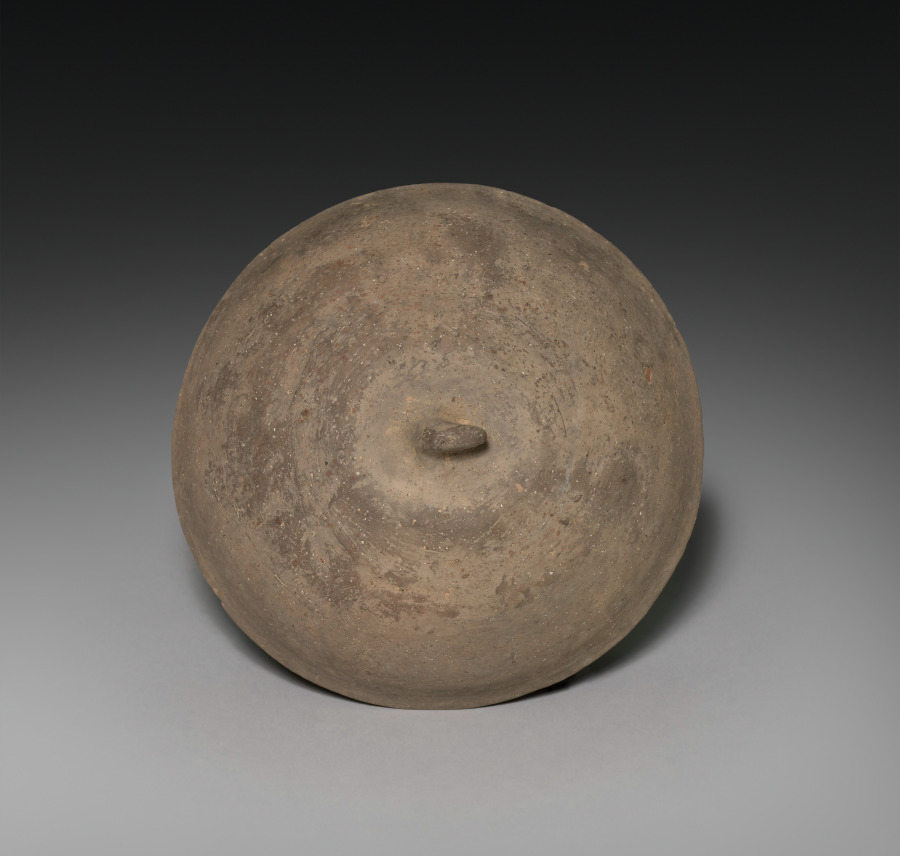
Lidded Jar with Four Horn Lugs (lid) (200s–400s CE) is in the Cleveland Museum of Art collection.
The work and its context
The museum's open-access catalogue describes the work:
Closed kilns built on hillsides became widely used for producing this type of pottery vessel in Korea during the Three Kingdoms period. Both its gray color and shimmering glaze are the result of the reduction of oxygen in the closed kiln chamber built on hillsides.
Object facts
- Title: Lidded Jar with Four Horn Lugs (lid)
- Date: 200s–400s CE
- Culture: Korea, Gaya period (42–562 CE)
- Type: Ceramic
- Technique: earthenware
- Dimensions: Diameter of mouth: 11.4 cm (4 1/2 in.); Overall: 25 x 21.5 cm (9 13/16 x 8 7/16 in.)
- Collection: Korean Art
- Department: Korean Art
- Accession number: 1997.8.b
A detail from the museum
This pottery vessel served to contain cremated remains, indicating the popularity of Buddhist mortuary practice in Korea during the Three Kingdoms period.
Collection credit
Leonard C. Hanna Jr. Fund
Further reading listed by the museum
- Ch'a, Mi-rae, Kwi-suk An, Cleveland Museum of Art, and 국외소재문화재재단. The Korean Collection of the Cleveland Museum of Art. Edited by An Min-hŭi. First edition, English ed. Overseas Korean Cultural Heritage Series, 16. Seoul, Republic of Korea: Overseas Korean Cultural Heritage Foundation, 2021.
View the collection record
See the museum's photographs and full catalogue entry. Catalogue text is reproduced from the Cleveland Museum of Art's open-access data, with HTML formatting removed. This object and its supplied image are designated CC0.
Sources
More in Lifestyle
Keep reading