Lidded Vessel with Loop Handles (57 BCE–668 CE): Art, History and Details
Lidded Vessel with Loop Handles at the Cleveland Museum of Art: 57 BCE–668 CE, earthenware, with impressed, paddled, and incised decoration and red slip. Explore the work's context, creator attribution and collection history.
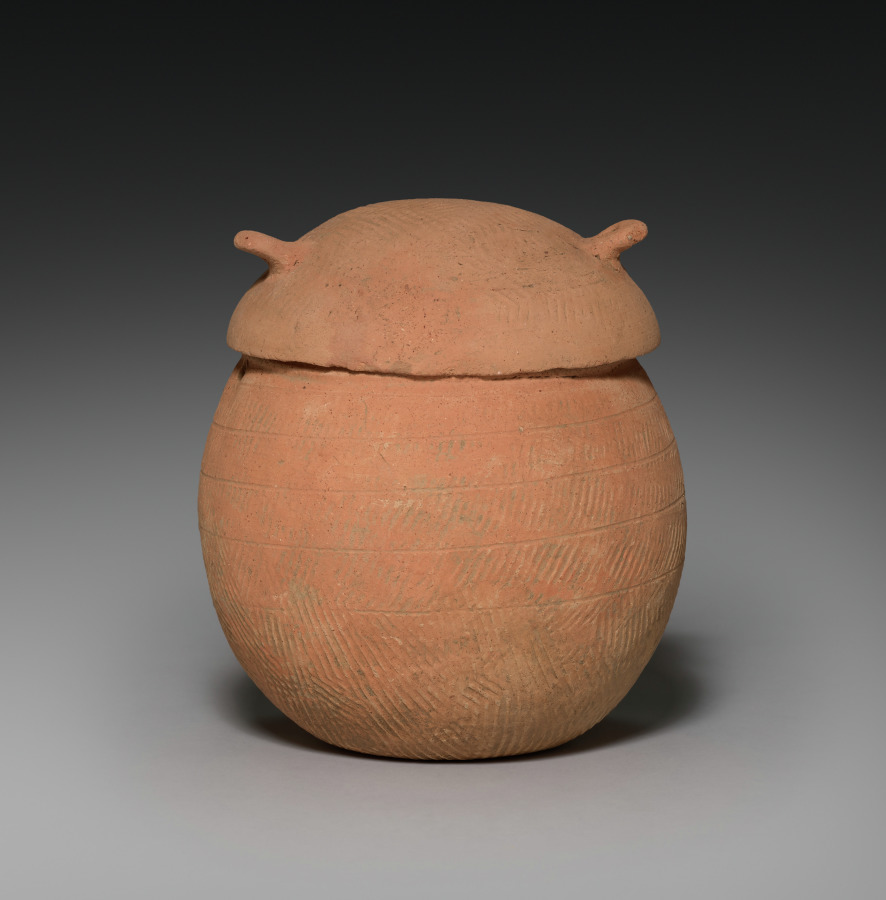
Lidded Vessel with Loop Handles (57 BCE–668 CE) is in the Cleveland Museum of Art collection.
The work and its context
The museum's open-access catalogue describes the work:
This small storage jar was hand built from coils of clay before it was finished on a potter's wheel. The thick, vertical ridges covering the surface were impressed into the wet clay using a carved wooden paddle. This network of raised lines was then intersected by four incised lines coursing around the bulbous form and separating the body into lower and upper areas with deft visual simplicity. Such direct, effective design solutions to ceramic decoration appear frequently in early Korean ceramics. The two perforations in the upper body were no doubt used to help secure the lid to the body with cord.
Object facts
- Title: Lidded Vessel with Loop Handles
- Date: 57 BCE–668 CE
- Culture: Korea, Three Kingdoms period (57 BCE–668 CE)
- Type: Ceramic
- Technique: earthenware, with impressed, paddled, and incised decoration and red slip
- Collection: Korean Art
- Department: Korean Art
- Accession number: 1999.228
A detail from the museum
Closed kilns built on hills became widely used for producing this type of pottery vessel in Korea during the Three Kingdoms period.
Collection credit
Gift of the Kang Collection of Korean Art in memory of Robert P. Bergman
Further reading listed by the museum
- Pottery from Ancient Korea: Clay Art for Life and Death [한국고대의토기 : 흙・예술・삶과 죽음]. Seoul: National Museum of Korea, 1997.
- Cleveland Museum of Art, “Cleveland Museum of Art Acquires Rare Chinese Paintings, Baroque Porcelain Plaque and Other New Acquisitions Exhibited with Hanging Scrolls,” December 20, 1999, Cleveland Museum of Art Archives.
- Choi, Sung-Rak. “How to study on the Potteries of the Iron? [철기시대토기의실체와연구방향]”. Chibangsawa chibangmunhwa 5, no. 2 (November 2002): 29–66.
View the collection record
See the museum's photographs and full catalogue entry. Catalogue text is reproduced from the Cleveland Museum of Art's open-access data, with HTML formatting removed. This object and its supplied image are designated CC0.
Sources
More in Lifestyle
Keep reading