Lions and Tigers in Peony and Bamboo (1668): Art, History and Details
Lions and Tigers in Peony and Bamboo at the Cleveland Museum of Art: 1668, pair of six-panel folding screens; ink and color on gilded paper. Explore the work's context, creator attribution and collection history.
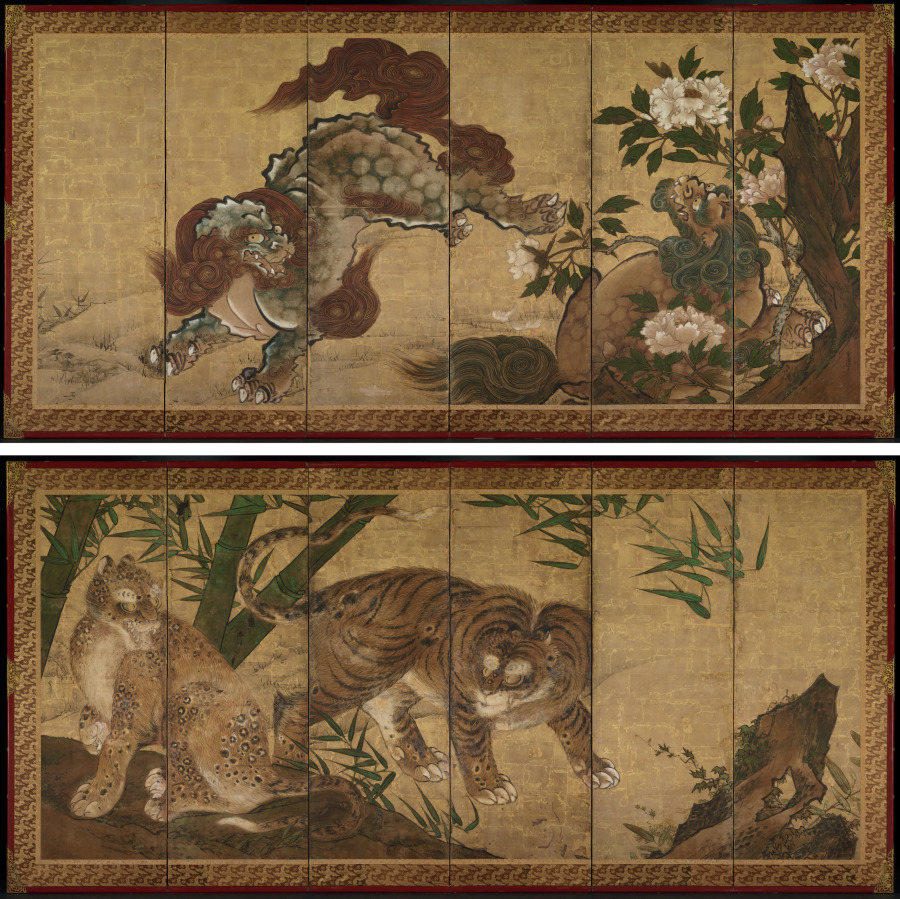
Lions and Tigers in Peony and Bamboo (1668) is in the Cleveland Museum of Art collection. The museum's creator attribution is Yamaguchi Sekkei (Japanese, 1644–1732).
The work and its context
The museum's open-access catalogue describes the work:
Sekkei lived and studied painting in Kyoto at the Kano school studio, the center of traditional painting activity in Japan since 1500. The use of gold foil as a backdrop for the frolicking animals served a practical as well as a decorative function. Because traditional Japanese rooms had no windows, interior lighting came from portable oil lamps and wax candles, whose effects were magnified by reflective surfaces.
Object facts
- Title: Lions and Tigers in Peony and Bamboo
- Date: 1668
- Creator attribution: Yamaguchi Sekkei (Japanese, 1644–1732)
- Culture: Japan, Edo period (1615–1868)
- Type: Painting
- Technique: pair of six-panel folding screens; ink and color on gilded paper
- Collection: ASIAN - Folding screen
- Department: Japanese Art
- Accession number: 1972.10
Collection credit
John L. Severance Fund
Further reading listed by the museum
- The Cleveland Museum of Art. Handbook of the Cleveland Museum of Art/1978. Cleveland, OH: The Cleveland Museum of Art, 1978.
- Cunningham, Michael R. "The Japanese Painter Yamaguchi Sekkei." The Bulletin of the Cleveland Museum of Art 67, no. 1 (1980): 2-16.
- Cunningham, Michael R. Unfolding Beauty: Japanese Screens from the Cleveland Museum of Art. Cleveland, OH: Cleveland Museum of Art, 2001.
View the collection record
See the museum's photographs and full catalogue entry. Catalogue text is reproduced from the Cleveland Museum of Art's open-access data, with HTML formatting removed. This object and its supplied image are designated CC0.
Sources
More in Lifestyle
Keep reading