Little Briar Rose (Sleeping Beauty) (1836): Art, History and Details
Little Briar Rose (Sleeping Beauty) at the Cleveland Museum of Art: 1836, steel etching. Explore the work's context, creator attribution and collection history.
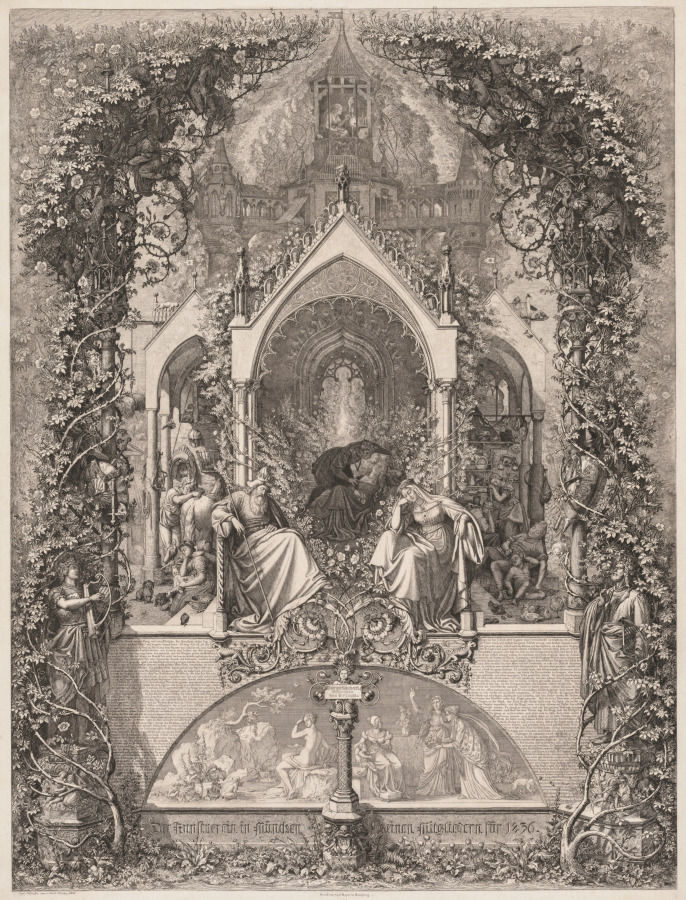
Little Briar Rose (Sleeping Beauty) (1836) is in the Cleveland Museum of Art collection. The museum's creator attribution is Eugen Napoleon Neureuther (German, 1806–1862).
The work and its context
The museum's open-access catalogue describes the work:
Eugen Napoleon Neureuther depicted a key episode from a classic fairy tale. The title character in Little Briar Rose is awakened from an enchanted sleep by a prince’s kiss. Neureuther centered the composition on the meeting with the prince that leads to the story’s happy ending. His portrayal coincided with a revived interest in such folktales in Germany during the 1800s, culminating in the publication of the Brothers Grimm’s Children’s and Household Tales in 1812. Neureuther used that book’s versions of the two tales as source material, even including a story’s text in one print.
Object facts
- Title: Little Briar Rose (Sleeping Beauty)
- Date: 1836
- Creator attribution: Eugen Napoleon Neureuther (German, 1806–1862)
- Culture: Germany, 19th century
- Type: Print
- Technique: steel etching
- Dimensions: Platemark: 66.5 x 50 cm (26 3/16 x 19 11/16 in.); Sheet: 72.5 x 54.5 cm (28 9/16 x 21 7/16 in.)
- Collection: PR - Etching
- Department: Prints
- Accession number: 1993.133
Collection credit
John L. Severance Fund
Further reading listed by the museum
- “1993 Annual Report.” The Bulletin of the Cleveland Museum of Art 81, no. 6 (July 1994): 143–218.
- Montañés-lleras, Susana. “Of Technology and Fantasy: fairy tales, fables, and the transformation of illustration in the long 19th century.” Gramarye : The Journal of the Sussex Centre for Folklore, Fairy Tales and Fantasy 28 (Winter 2025): 51-65.
View the collection record
See the museum's photographs and full catalogue entry. Catalogue text is reproduced from the Cleveland Museum of Art's open-access data, with HTML formatting removed. This object and its supplied image are designated CC0.
Sources
More in Lifestyle
Keep reading
Related stories