Mace Head (300–500 CE): Art, History and Details
Mace Head at the Cleveland Museum of Art: 300–500 CE, pecked and polished gray stone. Explore the work's context, creator attribution and collection history.
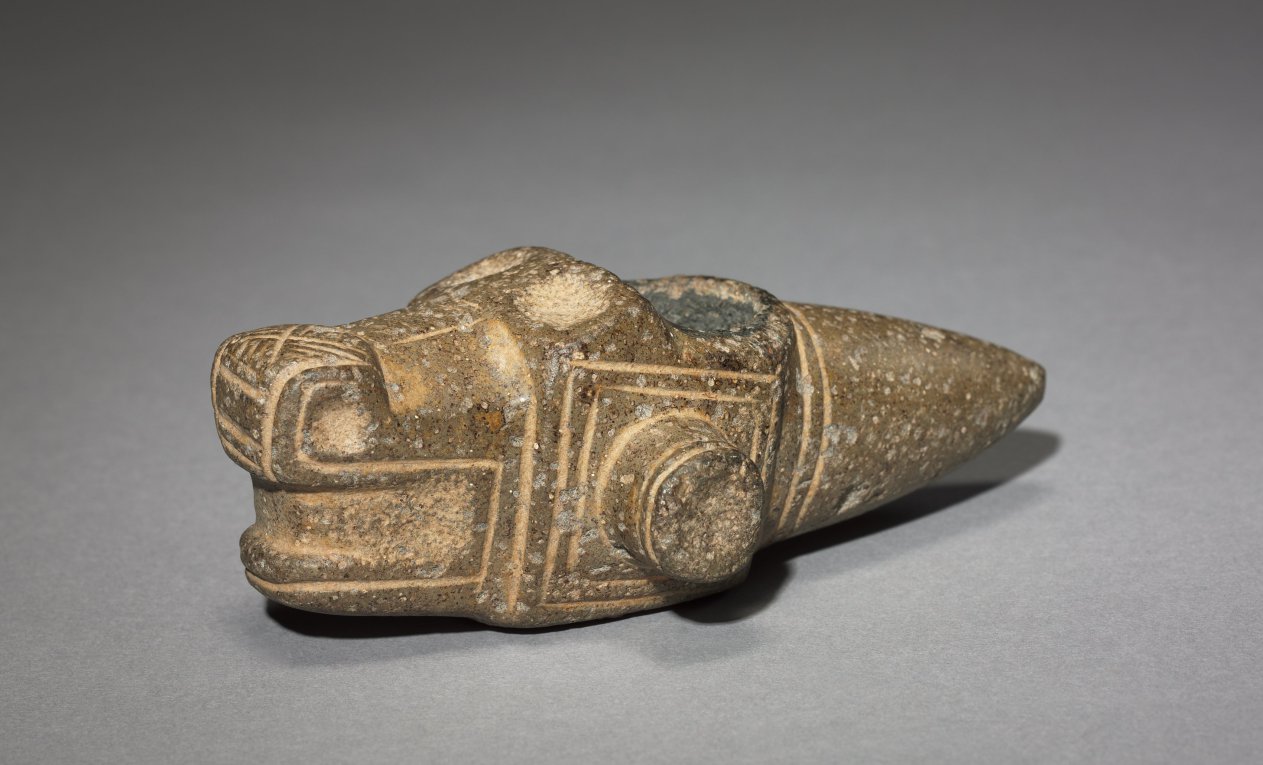
Mace Head (300–500 CE) is in the Cleveland Museum of Art collection.
The work and its context
The museum's open-access catalogue describes the work:
Once mounted on wooden shafts, elaborately shaped mace (club) heads like this one probably were not used as weapons. Rather, they could have served as emblems of chiefly authority, group insignia, the heads of ceremonial weapons, or all three. They eventually were placed in elite graves. The back-curled nose on this example may refer to a crocodile or caiman.
Object facts
- Title: Mace Head
- Date: 300–500 CE
- Culture: Costa Rica
- Type: Sculpture
- Technique: pecked and polished gray stone
- Dimensions: Overall: 4.2 x 7.3 x 13.6 cm (1 5/8 x 2 7/8 x 5 3/8 in.)
- Collection: AA - Intermediate Region
- Department: Art of the Americas
- Accession number: 1990.165
A detail from the museum
In ancient Costa Rica, it was believed that the world rested on the back of a crocodile.
Collection credit
Gift of Mr. and Mrs. James C. Gruener
Further reading listed by the museum
- Young-Sánchez, Margaret. "The Gruener Collection of Pre-Columbian Art." The Bulletin of the Cleveland Museum of Art 79, no. 7 (1992): 234-75.
View the collection record
See the museum's photographs and full catalogue entry. Catalogue text is reproduced from the Cleveland Museum of Art's open-access data, with HTML formatting removed. This object and its supplied image are designated CC0.
Sources
More in Lifestyle
Keep reading