Male Dog (200 BCE–300 CE): Art, History and Details
Male Dog at the Cleveland Museum of Art: 200 BCE–300 CE, earthenware with burnished red slip. Explore the work's context, creator attribution and collection history.
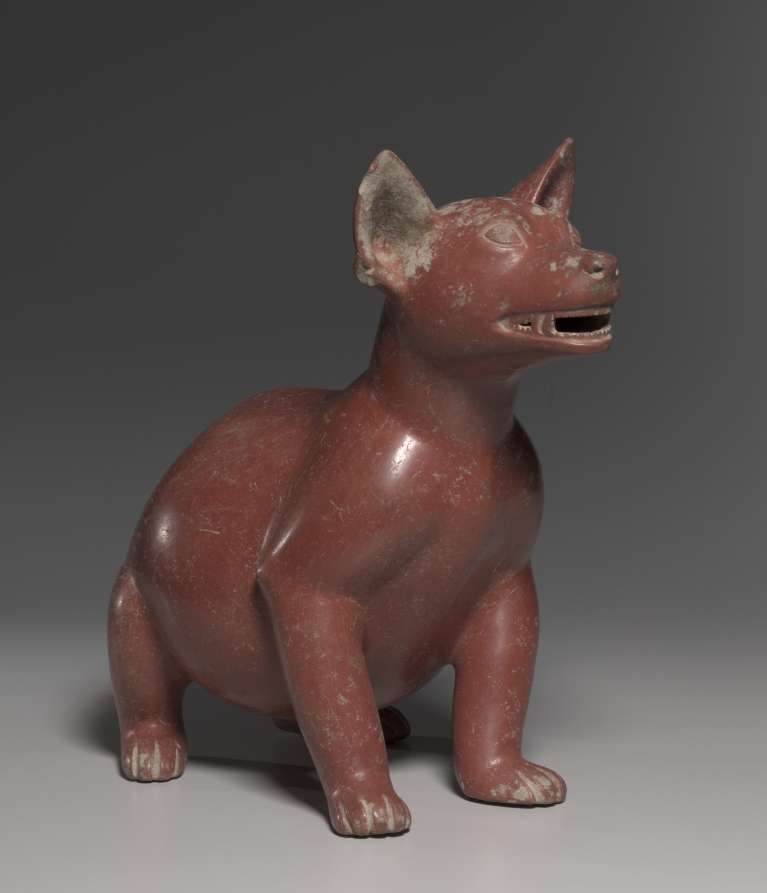
Male Dog (200 BCE–300 CE) is in the Cleveland Museum of Art collection.
The work and its context
The museum's open-access catalogue describes the work:
One of the best-known subjects of West Mexican tomb sculpture is the native hairless dog, which is shown naturalistically-as here-but also wearing a human mask, signaling complex meanings.These meanings are not well-understood, but like later Mesoamericans, West Mexicans may have believed that dogs served as guides or guards in the underworld realm of the dead. For the living, they also served as food.
Object facts
- Title: Male Dog
- Date: 200 BCE–300 CE
- Culture: West Mexico, Colima, Comala style
- Type: Sculpture
- Technique: earthenware with burnished red slip
- Dimensions: Overall: 39.5 x 20.8 x 47.8 cm (15 9/16 x 8 3/16 x 18 13/16 in.)
- Collection: AA - Mesoamerica
- Department: Art of the Americas
- Accession number: 1964.37
Collection credit
Cornelia Blakemore Warner Fund
Further reading listed by the museum
- The Cleveland Museum of Art. Handbook of the Cleveland Museum of Art/1966. Cleveland, OH: The Cleveland Museum of Art, 1966.
- The Cleveland Museum of Art. Handbook of the Cleveland Museum of Art/1969. Cleveland, OH: The Cleveland Museum of Art, 1969.
- The Cleveland Museum of Art. Handbook of the Cleveland Museum of Art/1978. Cleveland, OH: The Cleveland Museum of Art, 1978.
View the collection record
See the museum's photographs and full catalogue entry. Catalogue text is reproduced from the Cleveland Museum of Art's open-access data, with HTML formatting removed. This object and its supplied image are designated CC0.
Sources
More in Lifestyle
Keep reading