Male Figurine or Finial (early 1800s-early 1900s): Art, History and Details
Male Figurine or Finial at the Cleveland Museum of Art: early 1800s-early 1900s, Wood. Explore the work's context, creator attribution and collection history.
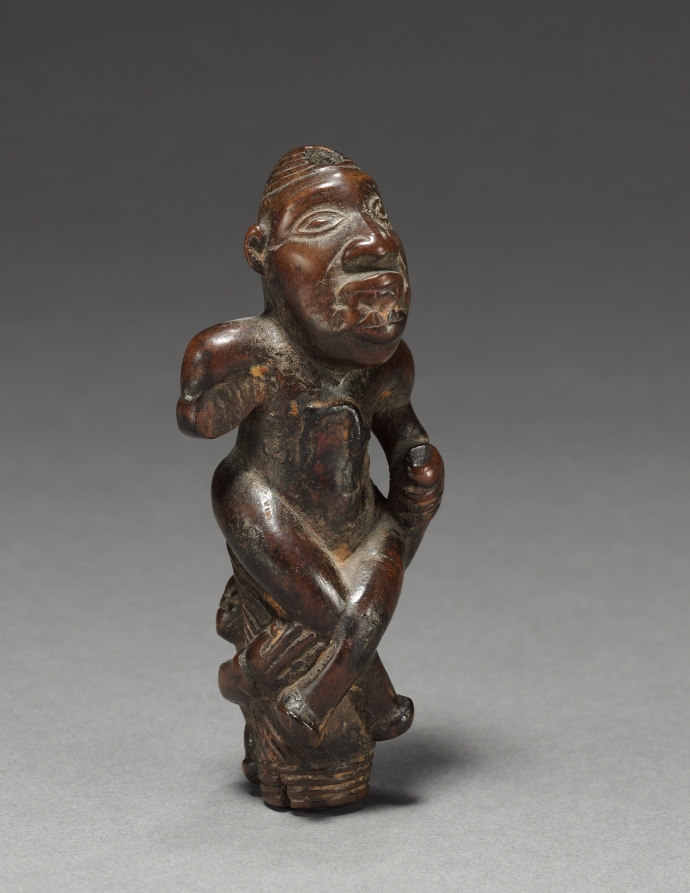
Male Figurine or Finial (early 1800s-early 1900s) is in the Cleveland Museum of Art collection.
The work and its context
The museum's open-access catalogue describes the work:
This figurine or finial may have contained a medicine-filled package on its abdomen. The man seated with his legs crossed and wearing a coiffure of Portuguese inspiration may represent a chief, which was once attached to a scepter or perhaps a flywhisk. Beneath the chief, a child holds onto his back; though such imagery is more typically seen with female sculptures.
Object facts
- Title: Male Figurine or Finial
- Date: early 1800s-early 1900s
- Culture: Central Africa, Democratic Republic of the Congo (most likely), Cabinda, or Republic of the Congo, probably Yombe people
- Type: Sculpture
- Technique: Wood
- Dimensions: Overall: 9.7 x 3.8 x 3.3 cm (3 13/16 x 1 1/2 x 1 5/16 in.)
- Collection: African Art
- Department: African Art
- Accession number: 2010.436
A detail from the museum
The stomach cavity was once filled with medicinal substances; once removed, the nkisi figure is considered “decommissioned.”
Collection credit
René and Odette Delenne Collection, Leonard C. Hanna Jr. Fund
Further reading listed by the museum
- Petridis, Constantine, et al. Fragments of the Invisible: The René and Odette Delenne Collection of Congo Sculpture. Cleveland, OH: Cleveland Museum of Art. Milan: 5 Continents Editions, 2013, 50.
View the collection record
See the museum's photographs and full catalogue entry. Catalogue text is reproduced from the Cleveland Museum of Art's open-access data, with HTML formatting removed. This object and its supplied image are designated CC0.
Sources
More in Lifestyle
Keep reading
Related stories