Man Dyeing Cloth (early 1830s): Art, History and Details
Man Dyeing Cloth at the Cleveland Museum of Art: early 1830s, Gum tempera and ink on paper. Explore the work's context, creator attribution and collection history.
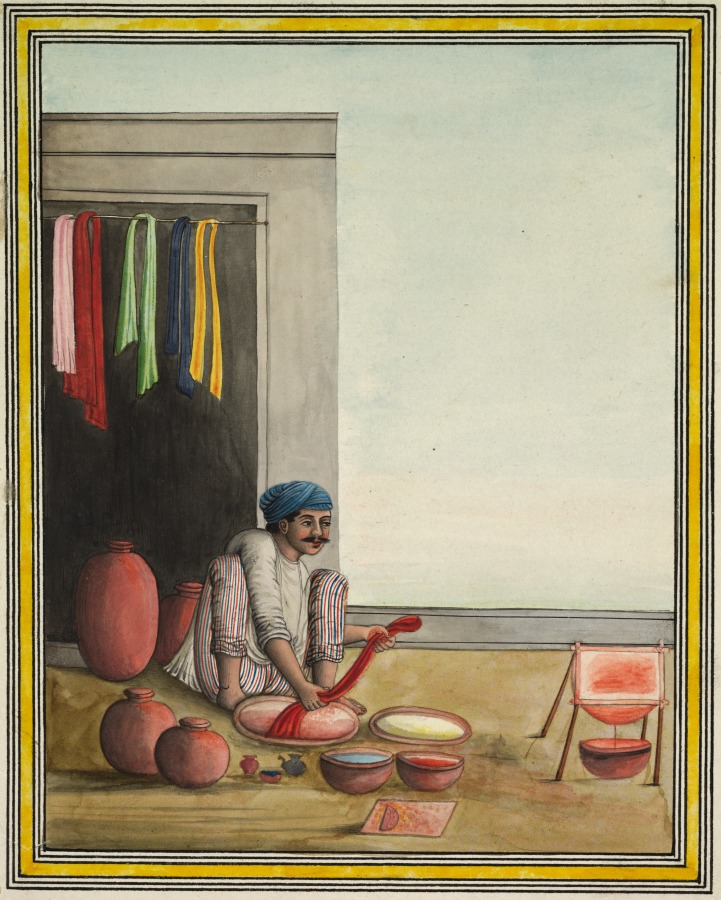
Man Dyeing Cloth (early 1830s) is in the Cleveland Museum of Art collection.
The work and its context
The museum's open-access catalogue describes the work:
Members of the British East India Company, largely merchants themselves, collected picture books that were compendiums of Indian professions and occupations, made by a new class of commercial Indian artists. They often emphasized the exotic and primitive aspects of life in India, such as the turbaned, pajama-clad man, squatting on the ground with a blank expression, making dye and hand-coloring strips of cloth using simple terracotta vessels.
Object facts
- Title: Man Dyeing Cloth
- Date: early 1830s
- Culture: India, Company School, Lucknow, 19th century
- Type: Painting
- Technique: Gum tempera and ink on paper
- Dimensions: Overall: 22.2 x 15.9 cm (8 3/4 x 6 1/4 in.)
- Collection: Indian Art
- Department: Indian and Southeast Asian Art
- Accession number: 1992.142
Collection credit
Seventy-fifth anniversary gift of William E. Ward in memory of his wife, Evelyn Svec Ward
Further reading listed by the museum
- Turner, Evan H. “The Year in Review for 1992.” The Bulletin of the Cleveland Museum of Art 80, no. 2 (February 1993): 38–79.
View the collection record
See the museum's photographs and full catalogue entry. Catalogue text is reproduced from the Cleveland Museum of Art's open-access data, with HTML formatting removed. This object and its supplied image are designated CC0.
Sources
More in Lifestyle
Keep reading