Mandaya ikat textile (dagmay) (c. early 1900s): Art, History and Details
Mandaya ikat textile (dagmay) at the Cleveland Museum of Art: c. early 1900s, plain weave hemp, dyed. Explore the work's context, creator attribution and collection history.
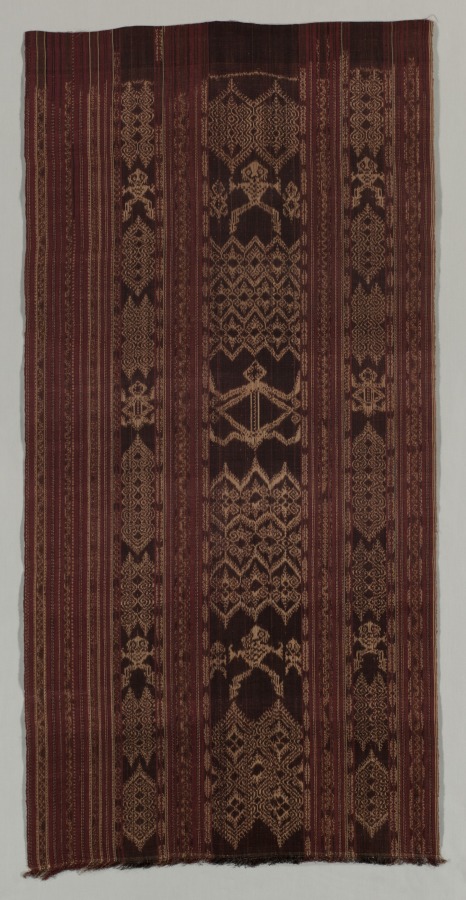
Mandaya ikat textile (dagmay) (c. early 1900s) is in the Cleveland Museum of Art collection.
The work and its context
The museum's open-access catalogue describes the work:
This textile is a Mandaya abacá ikat cloth woven in southeastern Mindanao. It is made from hand-stripped abacá fibers that are resist-dyed using the Mandaya ikat technique, in which selected warp threads are tightly bound before dyeing to produced patterned sections during weaving. The designs embody Mandaya cosmology and are traditionally associated with protection, fertility, and the presence of umagad (ancestral spirits).
Object facts
- Title: Mandaya ikat textile (dagmay)
- Date: c. early 1900s
- Culture: Philippines, Mindanao
- Type: Textile
- Technique: plain weave hemp, dyed
- Dimensions: Overall: 157.8 x 78.7 cm (62 1/8 x 31 in.)
- Collection: Textiles
- Department: Textiles
- Accession number: 1917.748
A detail from the museum
After weaving, abacá ikat cloths were soaked in iron-rich river mud, which deepens the browns and blacks, strengthens the fiber, and sets the dyes.
Collection credit
Gift of Mrs. G. Field Adams
View the collection record
See the museum's photographs and full catalogue entry. Catalogue text is reproduced from the Cleveland Museum of Art's open-access data, with HTML formatting removed. This object and its supplied image are designated CC0.
Sources
More in Lifestyle
Keep reading