Manjushri (c. 1500–1550): Art, History and Details
Manjushri at the Cleveland Museum of Art: c. 1500–1550, Hanging scroll, ink, color and gold on silk. Explore the work's context, creator attribution and collection history.
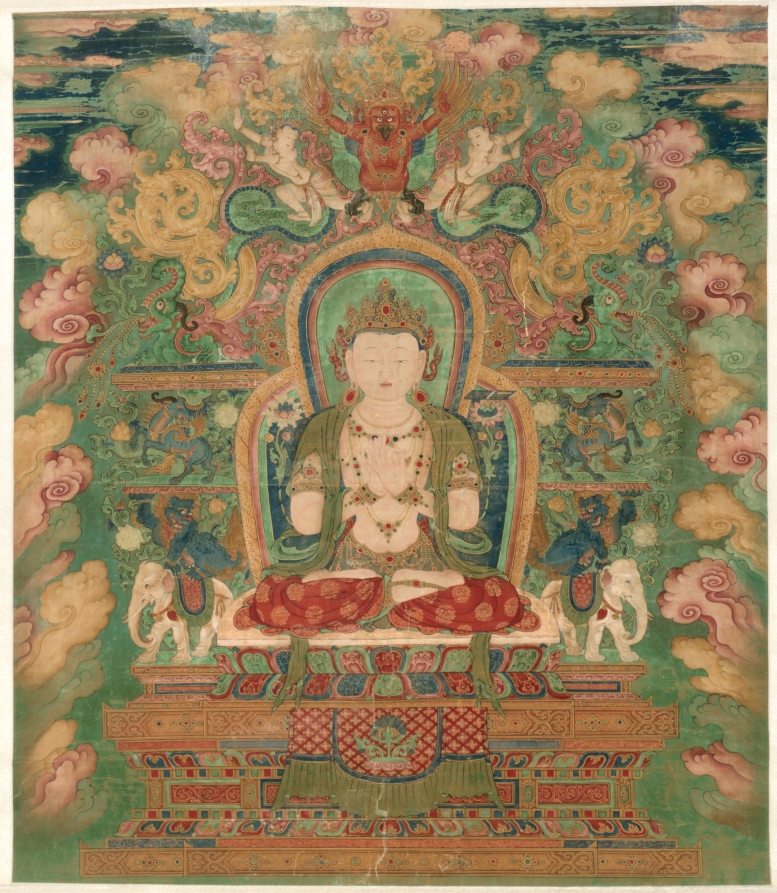
Manjushri (c. 1500–1550) is in the Cleveland Museum of Art collection.
The work and its context
The museum's open-access catalogue describes the work:
A Chinese artist's interpretation of an Indo-Nepalese throne surrounds the white figure of Manjushri, the bodhisattva of wisdom. Chinese textiles and jewels drape fluidly over the body, the red lower garment offering a contrast to the abundance of malachite green that dominates the composition. Swirling clouds of variegated hues around the periphery add to the mystical, almost magical mood of this iconic figure. His hands are in the gesture of imparting the Buddhist teachings, while his posture and expression reveal that wisdom can be perceived through the practice of yogic meditation.
Object facts
- Title: Manjushri
- Date: c. 1500–1550
- Culture: China, Ming dynasty (1368–1644)
- Type: Painting
- Technique: Hanging scroll, ink, color and gold on silk
- Dimensions: Painting: 124.8 x 107.3 cm (49 1/8 x 42 1/4 in.); Overall: 314.2 x 111.2 cm (123 11/16 x 43 3/4 in.); Overall with knobs: 314.2 x 122.8 cm (123 11/16 x 48 3/8 in.)
- Collection: ASIAN - Hanging scroll
- Department: Chinese Art
- Accession number: 1989.67
A detail from the museum
The book on the lotus by the figure's left shoulder identifies him as Manjushri, the bodhisattva of wisdom.
Collection credit
Mr. and Mrs. William H. Marlatt Fund
Further reading listed by the museum
- E. H. T. “The Year in Review: Selections 1989.” The Bulletin of the Cleveland Museum of Art 77, no. 2 (February 1990): 38–78.
View the collection record
See the museum's photographs and full catalogue entry. Catalogue text is reproduced from the Cleveland Museum of Art's open-access data, with HTML formatting removed. This object and its supplied image are designated CC0.
Sources
More in Lifestyle
Keep reading
Related stories