Mantle for a statue of the Virgin (late 1400s–1500s): Art, History and Details
Mantle for a statue of the Virgin at the Cleveland Museum of Art: late 1400s–1500s, Silk: lampas weave. Explore the work's context, creator attribution and collection history.
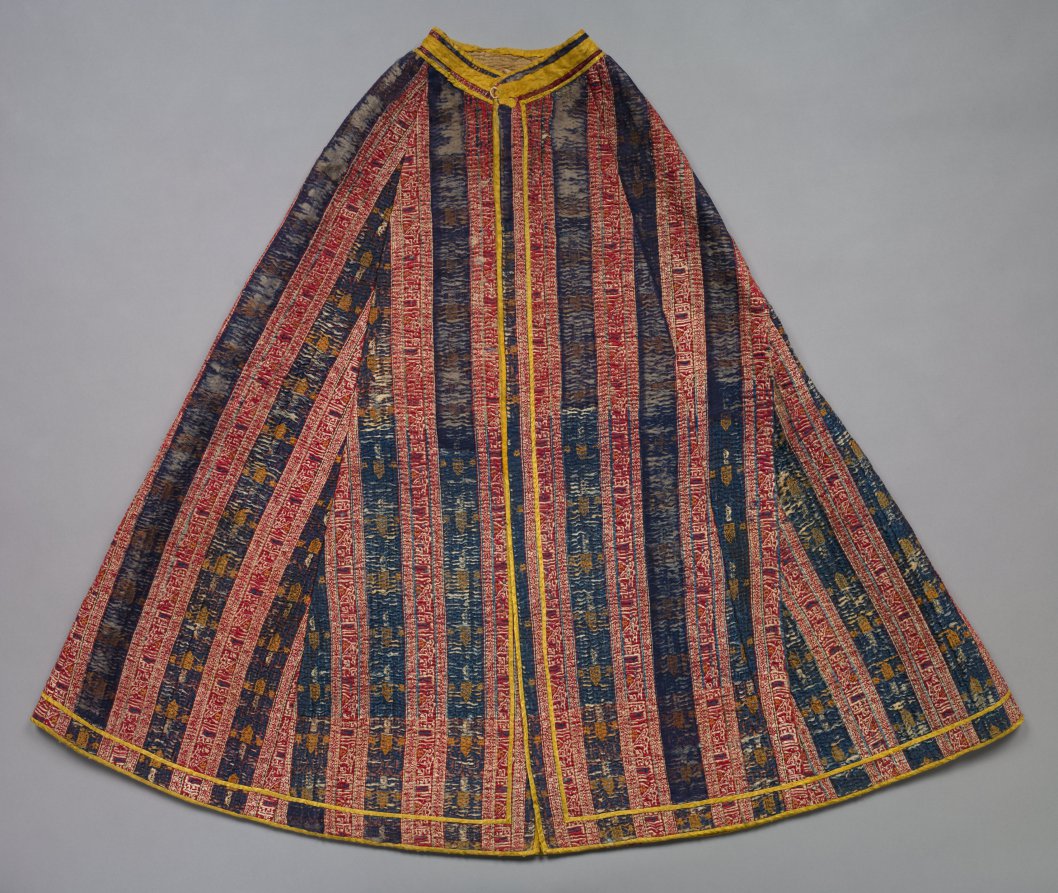
Mantle for a statue of the Virgin (late 1400s–1500s) is in the Cleveland Museum of Art collection.
The work and its context
The museum's open-access catalogue describes the work:
A striped silk textile, probably made for use in the Islamic Alhambra palatine complex, was turned into a mantle for a statue of the Virgin Mary. On the crimson stripes the salutation that occurs as ornamental text throughout the Alhambra, Glory to our Lord the Sultan, repeats in Arabic script.
Object facts
- Title: Mantle for a statue of the Virgin
- Date: late 1400s–1500s
- Culture: Spain, Granada
- Type: Textile
- Technique: Silk: lampas weave
- Dimensions: Average: 104.2 x 215.9 cm (41 x 85 in.)
- Collection: T - Islamic
- Department: Textiles
- Accession number: 1929.975
Collection credit
Purchase from the J. H. Wade Fund
Further reading listed by the museum
- G. U. (Gertrude Underhill) "A Hispano-Moresque Mantle of the Fifteenth Century." The Bulletin of the Cleveland Museum of Art 17, no. 4 (1930).
- Martin Nagy, Rebecca. Textiles in Daily Life in the Middle Ages. Cleveland, Ohio: Cleveland Museum of Art in cooperation with Indiana University Press, 1985.
- Mackie, Louise W. Symbols of Power: Luxury Textiles from Islamic Lands, 7th-21st Century. Cleveland; New Haven: Cleveland Museum of Art; Yale University Press, 2015.
View the collection record
See the museum's photographs and full catalogue entry. Catalogue text is reproduced from the Cleveland Museum of Art's open-access data, with HTML formatting removed. This object and its supplied image are designated CC0.
Sources
More in Lifestyle
Keep reading