Marigold (20th century): Art, History and Details
Marigold at the Cleveland Museum of Art: 20th century, plain weave cotton, printed. Explore the work's context, creator attribution and collection history.
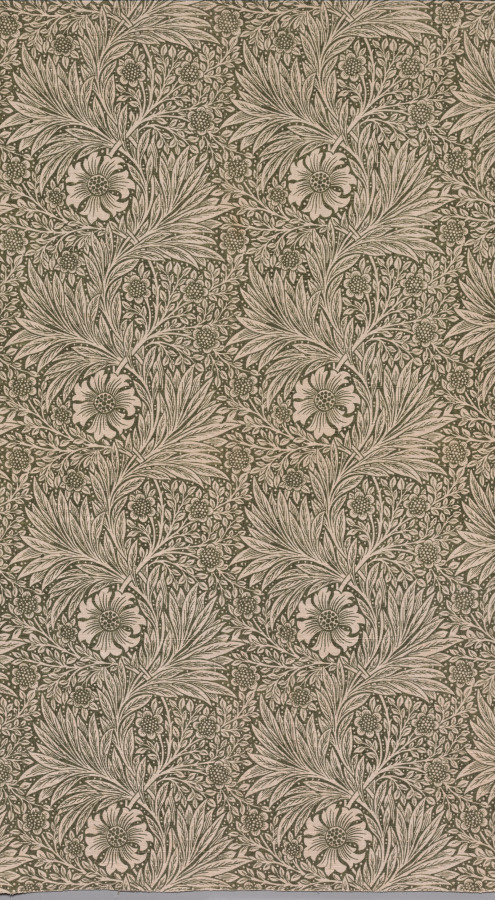
Marigold (20th century) is in the Cleveland Museum of Art collection. The museum's creator attribution is William Morris (British, 1834–1896).
The work and its context
The museum's open-access catalogue describes the work:
Among Morris’s first designs for printing on fabric, Marigold was originally intended for use on wallpaper, as seen in the image below. It was one of only a few patterns that clients could buy as both textile and wallpaper; it was also printed on linoleum. The wide variety of media available in Marigold speaks to the broad decorative application of its lively organic pattern. Here, blossoms and vines spread with ordered freedom, generating a sense of movement and demonstrating Morris’s revolutionary principle of “rational growth,” which set his designs apart from the formal, rigid patterns of his competitors.
Object facts
- Title: Marigold
- Date: 20th century
- Creator attribution: William Morris (British, 1834–1896)
- Culture: England, 20th century
- Type: Textile
- Technique: plain weave cotton, printed
- Dimensions: Overall: 91.4 x 92.7 cm (36 x 36 1/2 in.)
- Collection: Textiles
- Department: Textiles
- Accession number: 1937.699
Collection credit
Gift of Mrs. Henry Chisholm
Further reading listed by the museum
- Parry, Linda. William Morris Textiles. London: Weidenfeld and Nicolson, 1983.
- Korkow, Cory. "Textiles." IN William Morris: Designing an Earthly Paradise. Cory Korkow and Victoria Hepburn, 8-23. Cleveland, Ohio : Cleveland Museum of Art, 2017.
View the collection record
See the museum's photographs and full catalogue entry. Catalogue text is reproduced from the Cleveland Museum of Art's open-access data, with HTML formatting removed. This object and its supplied image are designated CC0.
Sources
More in Lifestyle
Keep reading