Mercury Orders Calypso to Allow Ulysses Depart (c. 1670): Art, History and Details
Mercury Orders Calypso to Allow Ulysses Depart at the Cleveland Museum of Art: c. 1670, etching. Explore the work's context, creator attribution and collection history.
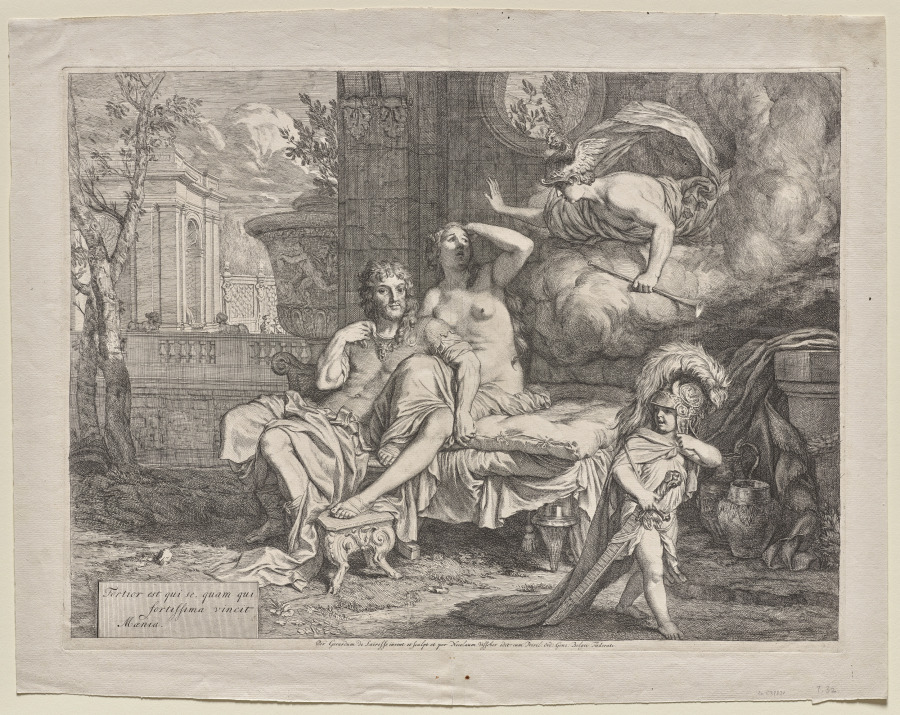
Mercury Orders Calypso to Allow Ulysses Depart (c. 1670) is in the Cleveland Museum of Art collection. The museum's creator attribution is Gerard de Lairesse (Flemish, 1641–1711); Nicolaes Visscher (Netherlandish, 1649–1702).
The work and its context
The museum's open-access catalogue describes the work:
In Homer’s Odyssey, Odysseus spends seven years captive to the nymph Calypso. Despite Calypso’s charms, Odysseus longed to return home to his family. In this composition, De Lairesse depicts the moment when the Olympian gods intervene, sending Hermes to release Odysseus from Calypso’s captivity. The Dutch De Lairesse brought French artistic taste to the Netherlands, reflected here in the firmly modeled, idealized figures and classical architecture.
Object facts
- Title: Mercury Orders Calypso to Allow Ulysses Depart
- Date: c. 1670
- Creator attribution: Gerard de Lairesse (Flemish, 1641–1711); Nicolaes Visscher (Netherlandish, 1649–1702)
- Culture: Netherlands
- Type: Print
- Technique: etching
- Dimensions: Sheet: 42.7 x 53.3 cm (16 13/16 x 21 in.); Matted: 45.7 x 61 cm (18 x 24 in.); Platemark: 35.7 x 47.9 cm (14 1/16 x 18 7/8 in.)
- Collection: PR - Etching
- Department: Prints
- Accession number: 2023.210
A detail from the museum
A painting by this artist of the same subject is also in the museum’s collection (see 1992.2).
Collection credit
Gift of James A. Bergquist in Loving Memory of Katherine Lee Reid
Further reading listed by the museum
- Timmers, J. J. M. Gérard Lairesse. Amsterdam: H.J. Paris, 1942.
- Roy, Alain. Gérard de Lairesse, 1640-1711. Paris: Arthena, 1992.
View the collection record
See the museum's photographs and full catalogue entry. Catalogue text is reproduced from the Cleveland Museum of Art's open-access data, with HTML formatting removed. This object and its supplied image are designated CC0.
Sources
More in Lifestyle
Keep reading