Mt. Fuji through Pines (late 1700s-early 1800s): Art, History and Details
Mt. Fuji through Pines at the Cleveland Museum of Art: late 1700s-early 1800s, hanging scroll, ink and color on silk. Explore the work's context, creator attribution and collection history.
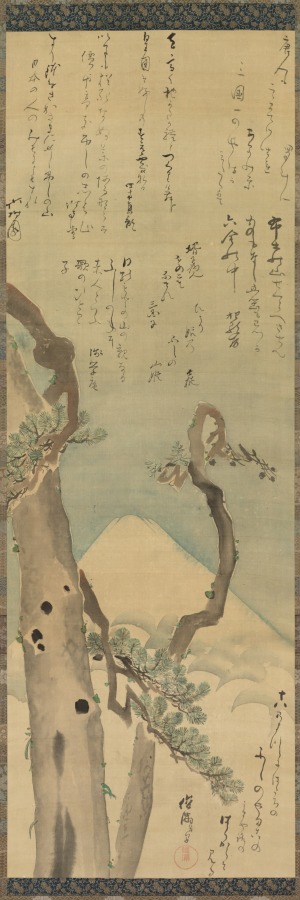
Mt. Fuji through Pines (late 1700s-early 1800s) is in the Cleveland Museum of Art collection. The museum's creator attribution is Kubo Shunman (Japanese, 1757–1820).
The work and its context
The museum's open-access catalogue describes the work:
Kubo Shunman dashed off this loose image of Mt. Fuji viewed in the distance from behind pine trees as a performance painting, or sekiga. He did it on the spot in the company of members of his poetry club. Six of them, including the club's founder Yadoya no Meshimori (Rokujuen, 1753–1830), added kyoka poems, 31-syllable poems like the classical Japanese waka poem in form, but with a heavy emphasis on humor. Shunman jotted down a poem as well, in the bottom right corner of the painting, before signing and sealing it. Each poem takes the painted image as its point of departure.
Object facts
- Title: Mt. Fuji through Pines
- Date: late 1700s-early 1800s
- Creator attribution: Kubo Shunman (Japanese, 1757–1820)
- Culture: Japan, Edo period (1615–1868)
- Type: Painting
- Technique: hanging scroll, ink and color on silk
- Dimensions: Painting only: 90 x 30.8 cm (35 7/16 x 12 1/8 in.); Including mounting: 183.5 x 49.5 cm (72 1/4 x 19 1/2 in.)
- Collection: ASIAN - Hanging scroll
- Department: Japanese Art
- Accession number: 1995.18
Collection credit
Kelvin Smith Fund
View the collection record
See the museum's photographs and full catalogue entry. Catalogue text is reproduced from the Cleveland Museum of Art's open-access data, with HTML formatting removed. This object and its supplied image are designated CC0.
Sources
More in Lifestyle
Keep reading