Naga Finial (1100s): Art, History and Details
Naga Finial at the Cleveland Museum of Art: 1100s, bronze. Explore the work's context, creator attribution and collection history.
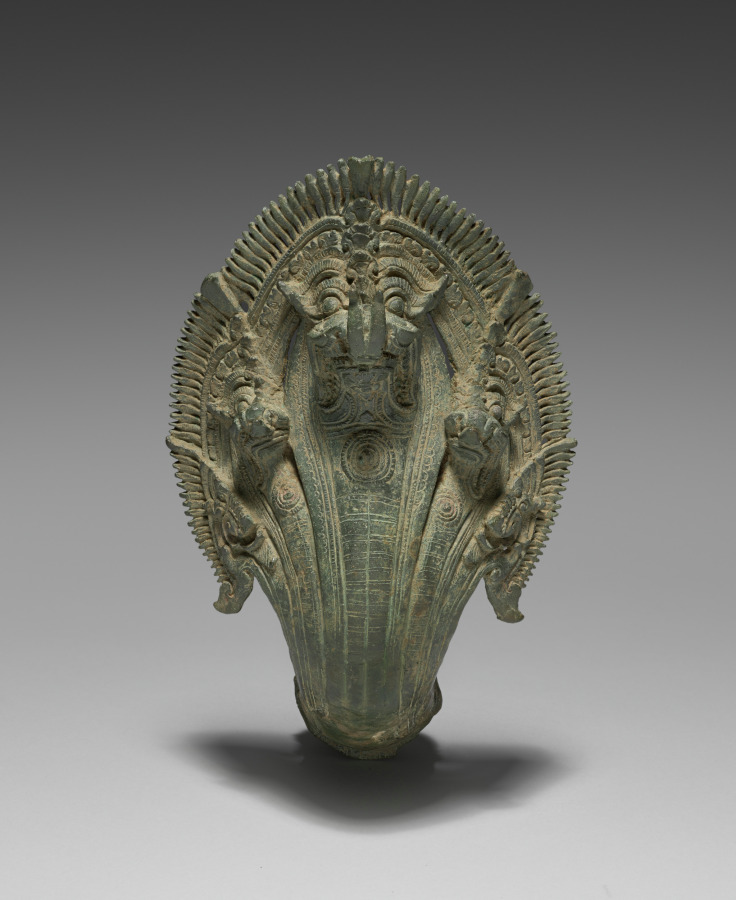
Naga Finial (1100s) is in the Cleveland Museum of Art collection.
The work and its context
The museum's open-access catalogue describes the work:
When members of the royal family or priesthood traveled in a public festival procession or to a temple to make offerings or participate in a ceremony, they would be carried in a palanquin, or a covered litter. Portable objects of veneration, such as bronze images or a sacred fire, were also carried on palanquins. The palanquins had wooden poles, hanging seats or raised platforms, and bronze fittings cast in intricate forms and gilt, lending the palanquins a sumptuous quality. The royal palanquins were typically fitted with multiheaded, serpent-shaped finials at the ends of the poles and corners of the elevated platforms. Naga means serpent in Sanskrit, a language from India selectively appropriated by the Khmer in Cambodia. In their own indigenous mythology, the Khmer people trace their descent from a naga princess and a prince from the island of Java who journeyed to Cambodia. The naga remains a potent emblem for the Khmer nation to this day; it is ubiquitous on Cambodian monuments.
Object facts
- Title: Naga Finial
- Date: 1100s
- Culture: Cambodia, Angkor Wat Period, 12th century
- Type: Metalwork
- Technique: bronze
- Dimensions: Overall: 29.2 x 15.2 x 15.2 cm (11 1/2 x 6 x 6 in.)
- Collection: Cambodian Art
- Department: Indian and Southeast Asian Art
- Accession number: 1987.14.1
Collection credit
Leonard C. Hanna Jr. Fund
View the collection record
See the museum's photographs and full catalogue entry. Catalogue text is reproduced from the Cleveland Museum of Art's open-access data, with HTML formatting removed. This object and its supplied image are designated CC0.
Sources
More in Lifestyle
Keep reading